Many products do not use GaN transistors. Conventional silicon MOSFETs, BJTs, IGBTs, and diodes still power most cost-sensitive, low-frequency, low-voltage, and legacy electronics. Silicon carbide devices are often preferred in very-high-voltage or high-power systems. GaN earns its place when fast switching, low charge, compact magnetics, and high power density create enough system value to justify specialized design.
It is rarely possible to identify the semiconductor technology by looking at the enclosure. A compact charger may use GaN, advanced silicon, or a hybrid chipset. The reliable evidence is the manufacturer documentation, schematic, bill of materials, or device marking.
Low-cost household electronics
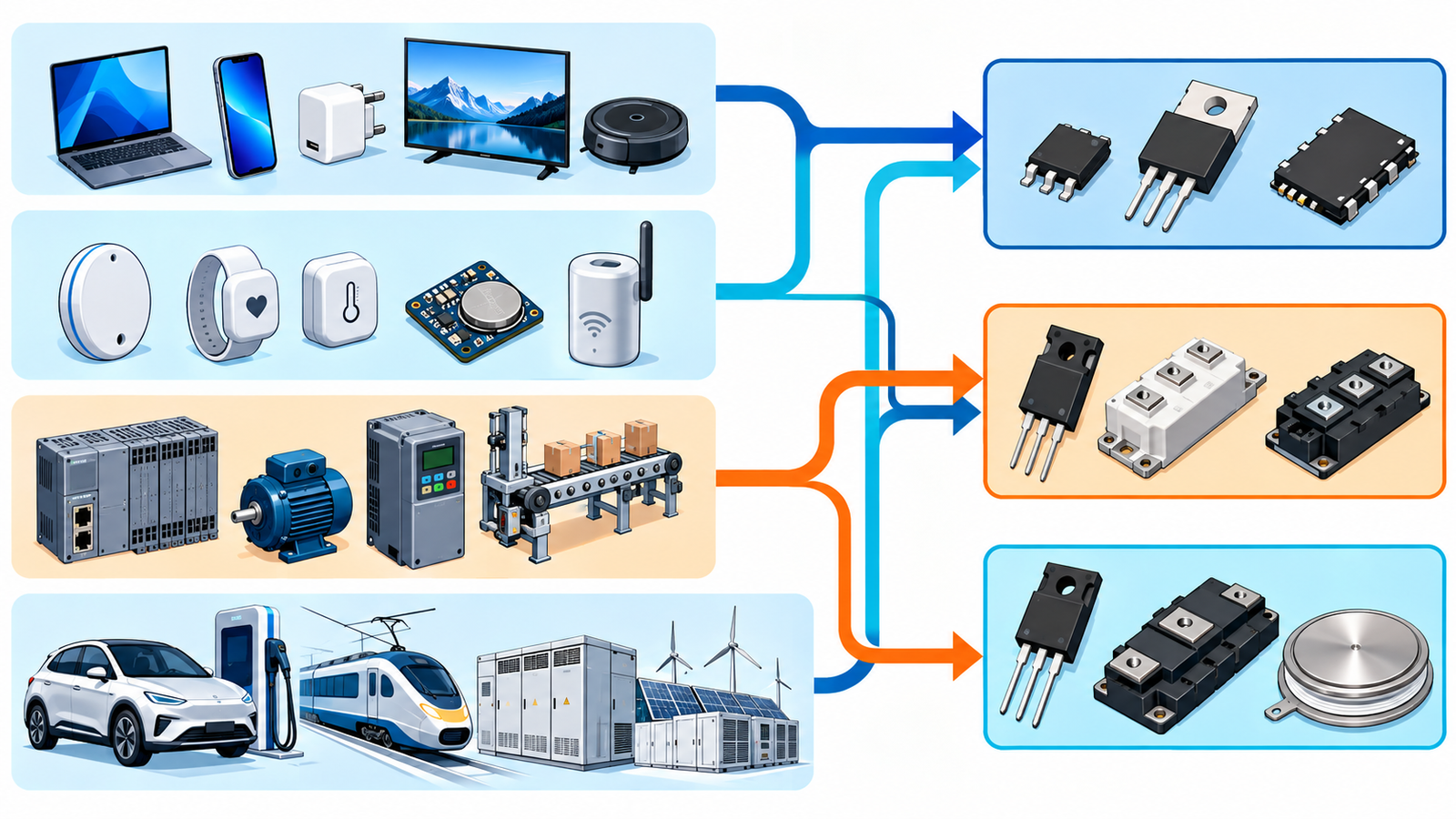
Simple clocks, toys, remote controls, basic LED products, inexpensive chargers, and standby supplies are often optimized around minimum cost and mature manufacturing. Their power level or switching frequency may be too low for smaller GaN magnetics to save meaningful space. An integrated silicon switch can combine adequate efficiency, protection, controller functions, and broad sourcing in one familiar package.
This does not mean no unit in the category can use GaN. Product generations and premium models differ. The article on where GaN transistors are used describes the applications that benefit most.
Very-low-voltage battery products
Wearables, sensor nodes, small microcontroller boards, and single-cell battery accessories commonly use low-voltage silicon MOSFETs. At a few volts, silicon devices can offer extremely low resistance, tiny packages, established protection ICs, and low cost. The converter frequency and passive size may already be constrained by efficiency at light load, acoustic behavior, or battery life rather than transistor switching speed.
GaN can serve low-voltage RF and specialized conversion roles, but the presence of a lithium battery, USB connector, or compact enclosure does not by itself imply GaN.
Linear and low-frequency equipment
Linear regulators, analog bias circuits, audio small-signal stages, relay controls, and mains-frequency switching may use BJTs or silicon MOSFETs because the device does not switch fast enough for GaN’s low charge to transform the system. A linear pass element dissipates voltage times current regardless of how quickly it could switch. In a relay replacement operating a few times per minute, gate charge is usually secondary to cost, leakage, package, and fault behavior.
Some high-performance audio amplifiers and RF transmitters do use GaN, so operating topology and frequency matter more than the product label.
High-voltage traction and grid hardware
Many traction inverters, megawatt drives, rail converters, wind systems, and high-voltage grid stages use IGBTs or SiC MOSFETs. These technologies offer established modules, voltage classes, current capability, short-circuit behavior, and thermal interfaces for demanding power levels. GaN increasingly reaches higher power, but it is not automatically the best device above common 650 V classes.
For the other wide-bandgap option, see what SiC MOSFETs are used for. The boundary moves as packaging and device ratings evolve.
Legacy and long-life industrial products
A product qualified years ago may retain silicon even when a newer transistor could improve efficiency. Redesign affects the gate driver, magnetics, PCB, EMI filter, thermal system, firmware, safety certification, supplier approval, and field reliability evidence. In industrial, medical, aerospace, or infrastructure equipment, avoiding unnecessary change can be more valuable than shrinking the converter.
Long availability, second sourcing, repair practice, and technician familiarity also influence the choice. A mature silicon design with comfortable thermal margin can be the lower-risk engineering decision.
Products where GaN adds no complete-system benefit
A faster transistor is useful only if the rest of the converter can exploit it. Large connector spacing, battery size, transformer isolation requirements, fan dimensions, enclosure standards, or load transients may set the product volume. If magnetics cannot shrink or EMI filtering grows, GaN may add cost without improving the customer-visible result.
Designers compare complete converter efficiency, density, thermal margin, compliance effort, component availability, and lifetime. The decision is not a contest between material data sheets.
Practical design review
To determine whether a specific product uses GaN, start with authoritative service documentation or regulatory photographs. Look up visible power-device markings and controller part numbers, but remember that package branding can be abbreviated and integrated GaN stages may hide the transistor die. Avoid opening mains-powered or sealed equipment merely to satisfy curiosity; charged capacitors, insulation damage, and warranty issues make casual teardown unsafe.
For a new design, establish a credible silicon baseline first. Then compare GaN at the same input range, output power, efficiency target, EMI limit, ambient, cooling, and lifetime. Include driver, magnetics, capacitors, heatsink, filter, PCB layers, assembly, and qualification. Use a structured SMPS design process and verify whether the higher practical frequency actually reduces total size and cost.
Marketing phrases such as fast charging, high density, or wide bandgap are clues, not proof of the switch technology in every revision. Manufacturers may change controllers or foundries while keeping the retail name. When technology matters for repair, compliance, or sourcing, verify the exact model number, region, hardware revision, and production date.
Frequently asked questions
Do all fast chargers use GaN?
No. Many compact chargers use advanced silicon switches, and some use a mix of technologies. Check the model’s technical documentation.
Do smartphones contain GaN transistors?
Some may include GaN in RF front ends or specialized power functions, but many internal power-management switches remain silicon. The bundled charger may use a different technology from the phone.
Why would a manufacturer choose silicon instead of GaN?
Silicon can offer lower cost, broad sourcing, familiar drive behavior, proven qualification, and sufficient efficiency for the product’s requirements.
Does a product without GaN have poor efficiency?
No. Topology, magnetics, control, load profile, layout, and thermal design matter. A well-designed silicon converter can be highly efficient.