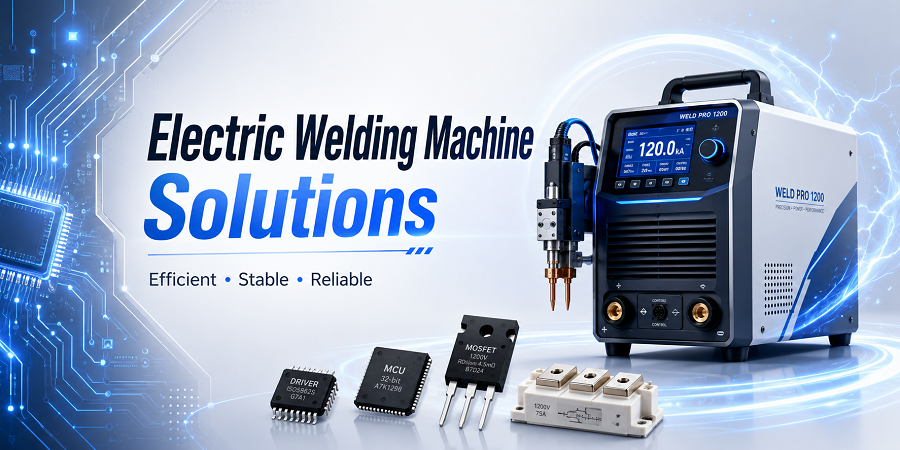
High-current inverter welding power platforms with active PFC, high-frequency isolation, fast secondary rectification and coordinated digital protection.
High-density power conversion for stable, controllable welding current
Inverter welding machines convert the AC mains into a controllable low-voltage, high-current output for stable arc ignition and precise weld-energy delivery. The architecture combines input filtering and rectification, active power-factor correction, a high-voltage DC link, a high-frequency inverter and isolation transformer, fast secondary rectification, output filtering and a coordinated controller that regulates welding current while supervising short-circuit, overvoltage and thermal conditions.
Key advantages
Universal AC input
Improved power factor
High DC-bus utilization
High-frequency isolation
Fast current regulation
Stable arc ignition
Low conduction loss
Reduced output ripple
Overcurrent and short protection
Thermal protection
Compact magnetic design
Scalable welding current
Welding inverter architecture and product mapping
Electric Welding Machine Architecture
AC input filtering and rectification, active PFC, high-voltage DC-link conversion, high-frequency inverter isolation, fast secondary rectification, output-current filtering and coordinated protection.
Tip: Select a block in the diagram or choose a module from the list. On mobile, swipe horizontally to view the full diagram.
Explore the welding power architecture through the interactive block diagram. Select PFC, the DC/DC inverter primary stage, the high-frequency rectifier, or the controller and protection module to review its design role and recommended MOT device categories.
About the solution
High-frequency isolated conversion for stable arc current and fast dynamic response
The solution rectifies and conditions the AC input, corrects power factor, stores energy on a regulated high-voltage DC link and drives a half-bridge or full-bridge inverter. A high-frequency transformer provides isolation and voltage step-down, while fast secondary rectifiers and an output choke deliver the low-voltage, high-current waveform required for reliable arc ignition, current control and weld-pool stability.
Designed for MMA, TIG, MIG/MAG and compact inverter welding platforms
The architecture can be scaled from portable single-phase welders to higher-power industrial equipment by adjusting PFC rating, DC-link voltage, bridge topology, transformer design, rectifier current capability and output inductance. Digital current control and coordinated protection support hot start, anti-stick, arc-force behavior, rapid load transitions and dependable operation under demanding shop-floor conditions.
Power devices and protection functions aligned with the complete welding energy path
High-voltage PFC MOSFETs and diodes, IGBTs or fast-switching MOSFETs for the inverter bridge, isolated gate drivers, high-current ultrafast rectifiers, current-sense amplifiers, digital controllers, voltage supervisors and temperature-monitoring devices provide a practical semiconductor platform for efficient, compact and robust welding-machine designs.
High-frequency isolated conversion for stable arc current and fast dynamic response
The solution rectifies and conditions the AC input, corrects power factor, stores energy on a regulated high-voltage DC link and drives a half-bridge or full-bridge inverter. A high-frequency transformer provides isolation and voltage step-down, while fast secondary rectifiers and an output choke deliver the low-voltage, high-current waveform required for reliable arc ignition, current control and weld-pool stability.
Designed for MMA, TIG, MIG/MAG and compact inverter welding platforms
The architecture can be scaled from portable single-phase welders to higher-power industrial equipment by adjusting PFC rating, DC-link voltage, bridge topology, transformer design, rectifier current capability and output inductance. Digital current control and coordinated protection support hot start, anti-stick, arc-force behavior, rapid load transitions and dependable operation under demanding shop-floor conditions.
Power devices and protection functions aligned with the complete welding energy path
High-voltage PFC MOSFETs and diodes, IGBTs or fast-switching MOSFETs for the inverter bridge, isolated gate drivers, high-current ultrafast rectifiers, current-sense amplifiers, digital controllers, voltage supervisors and temperature-monitoring devices provide a practical semiconductor platform for efficient, compact and robust welding-machine designs.
Contact our engineering team
Talk to Engineering Sales
Tell us your operating conditions and volume plan.
Share your target application, electrical requirements, package preference and estimated quantity. Our field application engineers will follow up with the right battery-charging devices and reference designs for your project.
Response from a dedicated FAE within 1 business day