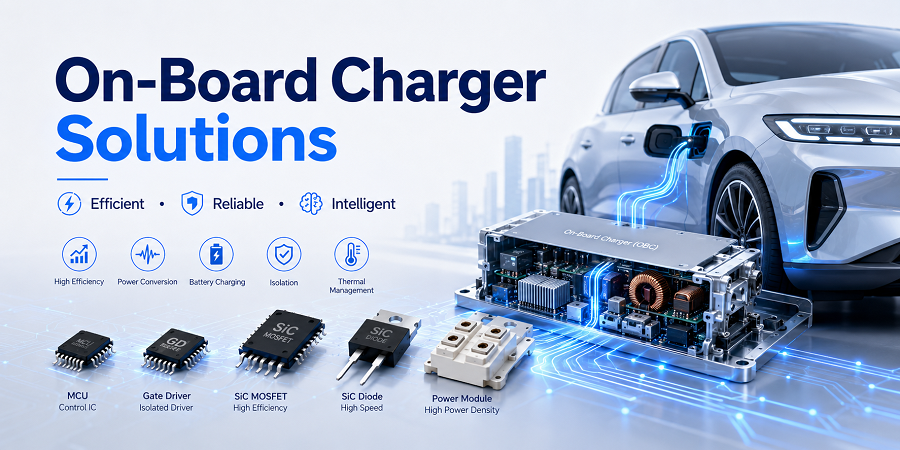
High-efficiency AC-to-battery power conversion for electric vehicles, with SiC PFC rectification designed to reduce reverse-recovery loss, thermal stress and switching energy in compact on-board charger platforms.
Efficient AC charging conversion for high-voltage EV battery systems
An on-board charger converts grid AC into an isolated, regulated DC charging output for the vehicle high-voltage battery. The power path typically includes input protection and EMI filtering, rectification and active PFC, a high-voltage DC link, an isolated DC/DC conversion stage, output filtering and vehicle-level communication and protection. Within the PFC path, a silicon-carbide boost diode can materially reduce reverse-recovery current and switching stress, helping improve efficiency, thermal margin and power density across wide line and load conditions.
Key advantages
Low reverse-recovery loss
High switching-frequency capability
Improved PFC efficiency
Reduced switch turn-on stress
Lower thermal dissipation
Compact magnetic components
Wide AC input support
High-voltage battery compatibility
Strong surge margin
Automotive thermal robustness
Scalable OBC power levels
Lower system cooling demand
On-board charger architecture and product mapping
EV On-Board Charger Architecture
AC input conditioning, PFC SiC rectification, high-voltage DC-link conversion, galvanic isolation, battery charging regulation and vehicle communication.
Tip: Select a block in the diagram or choose a module from the list. On mobile, swipe horizontally to view the full diagram.
Explore the on-board charger architecture through the interactive block diagram. Select the PFC SiC Diode block to review its electrical role, key selection criteria and placeholder MOT device mapping.
About the solution
Grid-to-battery conversion with PFC, galvanic isolation and coordinated charge control
The on-board charger receives AC power through input filtering and protection, creates a regulated high-voltage DC bus through active PFC and transfers energy across an isolated DC/DC stage to the traction battery. The PFC boost diode is exposed to high repetitive voltage, fast current transitions and elevated temperature. A SiC diode with negligible reverse-recovery charge can reduce commutation loss and switching stress while helping the converter operate at higher frequency and power density.
Scalable for passenger vehicles, commercial EVs and integrated charging systems
The architecture can be adapted for single-phase or three-phase input, 400 V or 800 V battery platforms and different charging-power targets. Device voltage rating, forward drop, surge-current capability, package thermal resistance and switching frequency should be coordinated with the PFC topology, cooling approach, EMC target and vehicle duty profile.
SiC diode options aligned with efficiency, thermal and voltage-margin requirements
The placeholder portfolio covers 650 V and 1200 V SiC Schottky diodes across multiple current classes and package styles. These devices can be evaluated for boost and interleaved PFC rectification, clamp paths and other high-frequency locations where low reverse-recovery energy, high-temperature capability and robust surge performance are valuable.
Grid-to-battery conversion with PFC, galvanic isolation and coordinated charge control
The on-board charger receives AC power through input filtering and protection, creates a regulated high-voltage DC bus through active PFC and transfers energy across an isolated DC/DC stage to the traction battery. The PFC boost diode is exposed to high repetitive voltage, fast current transitions and elevated temperature. A SiC diode with negligible reverse-recovery charge can reduce commutation loss and switching stress while helping the converter operate at higher frequency and power density.
Scalable for passenger vehicles, commercial EVs and integrated charging systems
The architecture can be adapted for single-phase or three-phase input, 400 V or 800 V battery platforms and different charging-power targets. Device voltage rating, forward drop, surge-current capability, package thermal resistance and switching frequency should be coordinated with the PFC topology, cooling approach, EMC target and vehicle duty profile.
SiC diode options aligned with efficiency, thermal and voltage-margin requirements
The placeholder portfolio covers 650 V and 1200 V SiC Schottky diodes across multiple current classes and package styles. These devices can be evaluated for boost and interleaved PFC rectification, clamp paths and other high-frequency locations where low reverse-recovery energy, high-temperature capability and robust surge performance are valuable.
Contact our engineering team
Talk to Engineering Sales
Tell us your operating conditions and volume plan.
Share your target application, electrical requirements, package preference and estimated quantity. Our field application engineers will follow up with the right battery-charging devices and reference designs for your project.
Response from a dedicated FAE within 1 business day