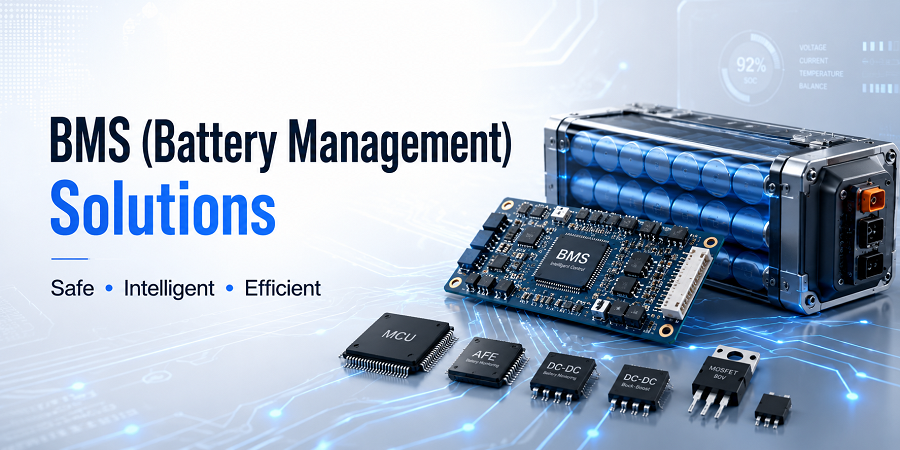
Accurate cell monitoring, controlled charge and discharge switching, and scalable balancing architectures for safe, efficient multi-cell battery packs.
Precision monitoring and protected power flow for multi-cell battery packs
A battery management system supervises every critical condition inside a rechargeable battery pack. The architecture measures individual cell voltages, pack current and temperature, controls the charge and discharge MOSFET path, and drives cell-balancing circuits to reduce state-of-charge mismatch. An AFE controller and monitor applies programmable protection thresholds, supports state-of-charge and state-of-health estimation, and communicates operating data to the host system. These functions help extend usable battery capacity, prevent unsafe operation and improve pack consistency over its service life.
Key advantages
Accurate multi-cell voltage monitoring
Bidirectional pack-current sensing
Charge and discharge protection
Passive or active cell balancing
Low standby consumption
Fast short-circuit response
Temperature supervision
Programmable protection thresholds
State-of-charge support
State-of-health diagnostics
Scalable cell-count architecture
Host communication readiness
Battery management architecture and product mapping
Battery Management System Architecture
Cell-stack monitoring, balance control, protected charge and discharge switching, pack-current and temperature supervision, and host communication.
Tip: Select a block in the diagram or choose a module from the list. On mobile, swipe horizontally to view the full diagram.
Explore the battery-management architecture through the interactive block diagram. Select Balance Driver, Charge & Discharge, or AFE Controller & Monitor to review the function, design priorities and placeholder MOT device mapping for each supported block.
About the solution
Cell-level measurement, balancing and protected pack-current control
A multi-cell BMS combines a precision analog front end with charge and discharge MOSFET control, cell-balancing drivers and temperature and current sensing. The monitor continuously compares every cell and pack condition against programmable thresholds, opens the power path when an unsafe state is detected and exchanges status information with the host. Balancing reduces cell mismatch so more of the pack capacity remains usable without overcharging the strongest cell or overdischarging the weakest cell.
Scalable across energy storage, power tools, mobility and industrial battery packs
The same functional platform can be adapted for portable energy storage, e-bikes and scooters, power tools, garden equipment, robotics, backup-power modules, industrial instruments and other rechargeable systems. Cell count, chemistry, charge current, discharge current, balancing strategy, protection timing and communication interface can be selected for the pack voltage, capacity, peak load and required safety margin.
Device categories aligned with cell balancing, pack switching and precision monitoring
Low-resistance charge and discharge MOSFETs, balancing switches and drivers, precision AFE monitors, current-sense amplifiers, shunt interfaces, temperature supervisors, voltage references, protection controllers and communication devices provide a practical semiconductor platform for accurate, efficient and serviceable battery-management designs.
Cell-level measurement, balancing and protected pack-current control
A multi-cell BMS combines a precision analog front end with charge and discharge MOSFET control, cell-balancing drivers and temperature and current sensing. The monitor continuously compares every cell and pack condition against programmable thresholds, opens the power path when an unsafe state is detected and exchanges status information with the host. Balancing reduces cell mismatch so more of the pack capacity remains usable without overcharging the strongest cell or overdischarging the weakest cell.
Scalable across energy storage, power tools, mobility and industrial battery packs
The same functional platform can be adapted for portable energy storage, e-bikes and scooters, power tools, garden equipment, robotics, backup-power modules, industrial instruments and other rechargeable systems. Cell count, chemistry, charge current, discharge current, balancing strategy, protection timing and communication interface can be selected for the pack voltage, capacity, peak load and required safety margin.
Device categories aligned with cell balancing, pack switching and precision monitoring
Low-resistance charge and discharge MOSFETs, balancing switches and drivers, precision AFE monitors, current-sense amplifiers, shunt interfaces, temperature supervisors, voltage references, protection controllers and communication devices provide a practical semiconductor platform for accurate, efficient and serviceable battery-management designs.
Contact our engineering team
Talk to Engineering Sales
Tell us your operating conditions and volume plan.
Share your target application, electrical requirements, package preference and estimated quantity. Our field application engineers will follow up with the right battery-charging devices and reference designs for your project.
Response from a dedicated FAE within 1 business day