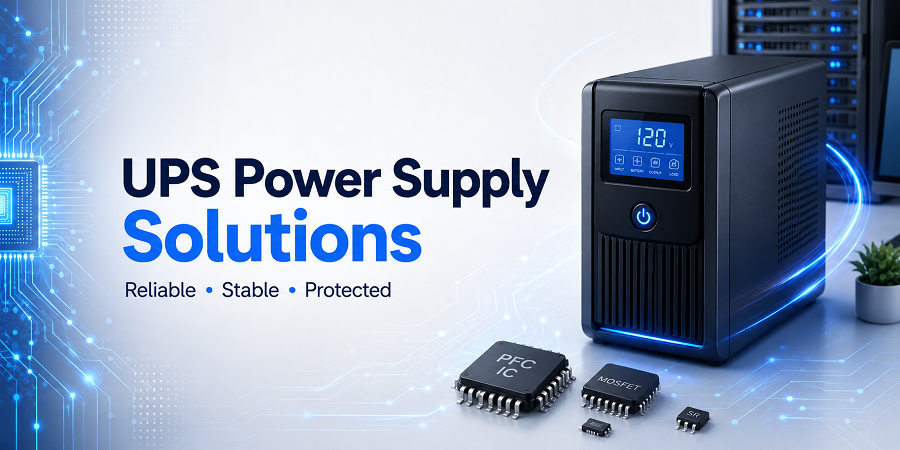
High-efficiency uninterruptible power architectures that combine active PFC, bidirectional battery energy management, low-distortion inversion, seamless bypass transfer and real-time system supervision.
Resilient power conversion for uninterrupted critical loads
Online UPS systems maintain continuous, regulated AC power by coordinating a high-power-factor input stage, a stable DC link, bidirectional battery charging and discharge, a low-distortion inverter and an automatic static-bypass path. The architecture must transition between utility, battery and bypass operation without interrupting critical loads while managing battery state, thermal limits, overload events, short circuits, grid disturbances and remote diagnostics.
Key advantages
High input power factor
Low input current THD
Seamless backup transfer
Bidirectional battery control
Low-distortion AC output
Fast static-bypass response
Wide battery-voltage support
High conversion efficiency
Overload and short-circuit protection
Battery health monitoring
Remote telemetry readiness
Scalable system power
UPS architecture and product mapping
Online UPS Power Architecture
AC input conditioning, active PFC, DC-link regulation, bidirectional battery charging, low-distortion inversion, static bypass and supervisory control.
Tip: Select a block in the diagram or choose a module from the list. On mobile, swipe horizontally to view the full diagram.
Explore the UPS power architecture through an interactive block diagram. Select PFC, the bidirectional DC/DC charger, battery pack, inverter or main controller to review its design role, key engineering considerations and recommended MOT device categories.
About the solution
Double-conversion power flow with coordinated battery energy and bypass control
The UPS converts utility AC into a regulated DC link through an active PFC stage, then recreates a clean, stable AC output through the inverter. A bidirectional DC/DC stage charges the battery during normal operation and returns stored energy to the DC link during an outage. The main controller synchronizes PFC, charger, inverter, static bypass, protection and telemetry functions to maintain uninterrupted output under changing line, load and battery conditions.
Scalable for data centers, telecom infrastructure, industrial automation and medical systems
The same functional platform can be adapted from compact single-phase UPS products to higher-power modular and rack systems. Semiconductor voltage rating, switching topology, battery voltage, inverter modulation, thermal design, overload capability, bypass strategy and communication interfaces can be scaled to match servers, networking equipment, process controls, security systems and other mission-critical loads.
Device categories aligned with the rectifier, battery, inverter and supervisory control paths
PFC MOSFETs and controllers, high-current gate drivers, bidirectional converter switches, battery-protection MOSFETs, sensing devices, inverter power transistors, isolated drivers, current and voltage supervisors, digital power controllers and communication interfaces provide a practical component platform for efficient, robust and serviceable UPS designs.
Double-conversion power flow with coordinated battery energy and bypass control
The UPS converts utility AC into a regulated DC link through an active PFC stage, then recreates a clean, stable AC output through the inverter. A bidirectional DC/DC stage charges the battery during normal operation and returns stored energy to the DC link during an outage. The main controller synchronizes PFC, charger, inverter, static bypass, protection and telemetry functions to maintain uninterrupted output under changing line, load and battery conditions.
Scalable for data centers, telecom infrastructure, industrial automation and medical systems
The same functional platform can be adapted from compact single-phase UPS products to higher-power modular and rack systems. Semiconductor voltage rating, switching topology, battery voltage, inverter modulation, thermal design, overload capability, bypass strategy and communication interfaces can be scaled to match servers, networking equipment, process controls, security systems and other mission-critical loads.
Device categories aligned with the rectifier, battery, inverter and supervisory control paths
PFC MOSFETs and controllers, high-current gate drivers, bidirectional converter switches, battery-protection MOSFETs, sensing devices, inverter power transistors, isolated drivers, current and voltage supervisors, digital power controllers and communication interfaces provide a practical component platform for efficient, robust and serviceable UPS designs.
Contact our engineering team
Talk to Engineering Sales
Tell us your operating conditions and volume plan.
Share your target application, electrical requirements, package preference and estimated quantity. Our field application engineers will follow up with the right battery-charging devices and reference designs for your project.
Response from a dedicated FAE within 1 business day