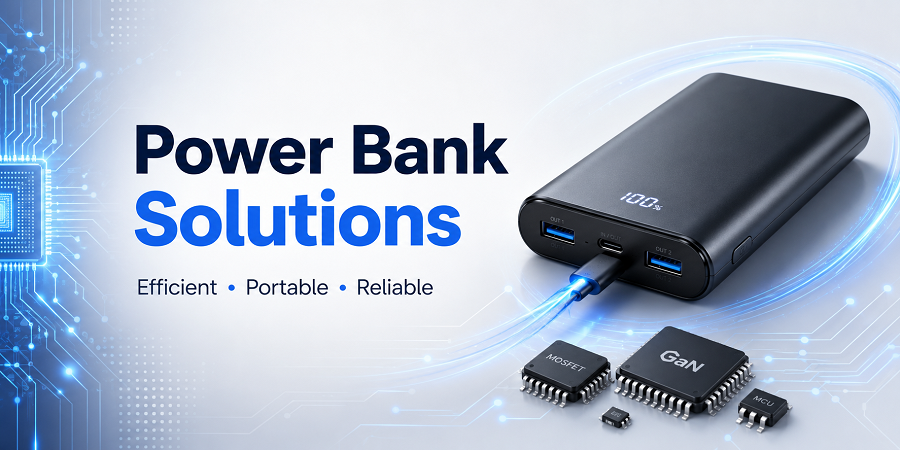
Bidirectional, protected and thermally optimized power conversion for USB-C power banks, portable battery packs and backup-energy products.
Bidirectional charging and regulated VBUS delivery for portable energy systems
Power banks exchange energy between a USB-C VBUS connection and one or more lithium-ion cells. The architecture combines a protected VBUS interface, a reverse-blocking power switch, a high-efficiency bidirectional buck-boost converter and a battery-management system that supervises cell voltage, current and temperature. A USB PD and system controller coordinates source/sink role negotiation, charging profiles, power-path sequencing, thermal derating and fault response.
Key advantages
Bidirectional USB-C power flow
High-efficiency buck-boost conversion
Accurate battery charging
Stable regulated VBUS
Low standby current
Fast source / sink role swap
Single- and multi-cell scalability
Cell balancing support
OVP / OCP / OTP protection
Reverse-current blocking
Compact thermal design
Fuel gauging and telemetry
Power bank architecture and product mapping
Bidirectional Power Bank Architecture
USB-C input/output, protected VBUS handling, a reverse-blocking power switch, bidirectional buck-boost conversion, battery-cell management and coordinated PD control.
Tip: Select a block in the diagram or choose a module from the list. On mobile, swipe horizontally to view the full diagram.
Explore the power-bank architecture through an interactive image map. Select BMS, the bidirectional DC/DC converter, VBUS interface, or power switch to review its design role and recommended MOT device categories.
About the solution
Bidirectional USB-C energy transfer with coordinated battery protection
The solution combines a protected USB-C VBUS interface, back-to-back power switching, a bidirectional synchronous buck-boost stage, lithium-ion battery cells and a dedicated BMS. The USB PD and system controller coordinates source and sink roles, charging current, regulated output voltage, thermal derating and fault isolation so the same port can charge the pack or power an external device safely and efficiently.
Scalable for compact power banks, laptop battery packs and portable backup power
The same functional platform can be adapted for pocket-size smartphone power banks, high-capacity laptop power banks, travel battery packs, portable routers, camera and drone accessories, industrial handheld equipment and small backup-energy modules. Cell count, converter phase count, VBUS voltage range, connector configuration and thermal design can be scaled to match capacity, output power and enclosure constraints.
Power, protection and battery-management devices aligned with every critical stage
Battery-monitoring and protection ICs, fuel-gauge and balancing functions, low-resistance MOSFETs, eFuses and ideal-diode controllers, VBUS protection devices, current-sense amplifiers, synchronous buck-boost controllers and gate drivers provide a practical component platform for compact, efficient and reliable power-bank designs.
Bidirectional USB-C energy transfer with coordinated battery protection
The solution combines a protected USB-C VBUS interface, back-to-back power switching, a bidirectional synchronous buck-boost stage, lithium-ion battery cells and a dedicated BMS. The USB PD and system controller coordinates source and sink roles, charging current, regulated output voltage, thermal derating and fault isolation so the same port can charge the pack or power an external device safely and efficiently.
Scalable for compact power banks, laptop battery packs and portable backup power
The same functional platform can be adapted for pocket-size smartphone power banks, high-capacity laptop power banks, travel battery packs, portable routers, camera and drone accessories, industrial handheld equipment and small backup-energy modules. Cell count, converter phase count, VBUS voltage range, connector configuration and thermal design can be scaled to match capacity, output power and enclosure constraints.
Power, protection and battery-management devices aligned with every critical stage
Battery-monitoring and protection ICs, fuel-gauge and balancing functions, low-resistance MOSFETs, eFuses and ideal-diode controllers, VBUS protection devices, current-sense amplifiers, synchronous buck-boost controllers and gate drivers provide a practical component platform for compact, efficient and reliable power-bank designs.
Contact our engineering team
Talk to Engineering Sales
Tell us your operating conditions and volume plan.
Share your target application, electrical requirements, package preference and estimated quantity. Our field application engineers will follow up with the right battery-charging devices and reference designs for your project.
Response from a dedicated FAE within 1 business day