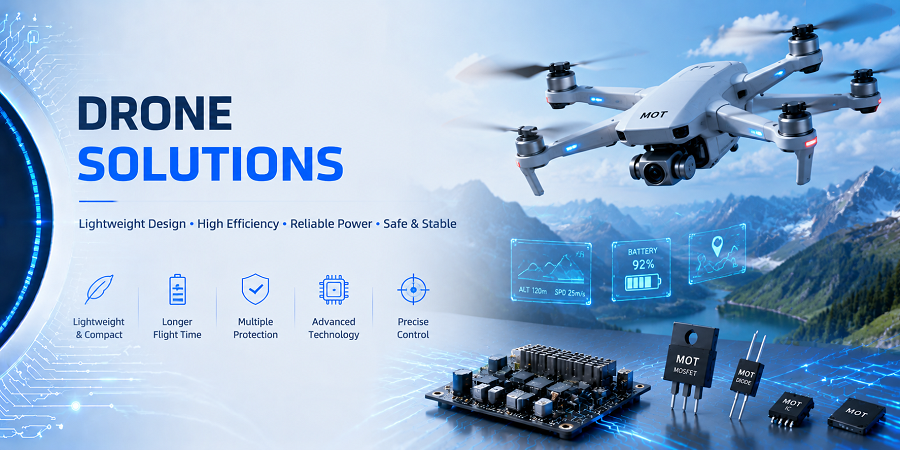
High-efficiency battery, power-conversion and motor-drive semiconductor solutions for multirotor drones, aerial imaging platforms, inspection UAVs and compact autonomous aircraft.
Overview
Drone power architectures must deliver high pulse current to the propulsion system while maintaining clean, stable rails for flight control, sensing, navigation, video and radio subsystems. A practical design combines a protected battery pack, compact DC/DC conversion, low-loss BLDC motor drivers and an MCU-based controller with communication interfaces. Coordinating these blocks helps improve flight time, reduce thermal stress, maintain stable control-loop performance and protect the aircraft during startup, rapid throttle changes, motor stall, battery undervoltage and other abnormal conditions.
Key advantages
High propulsion efficiency
Extended flight endurance
High peak-current capability
Compact power density
Stable avionics power rails
Fast motor-current response
Low conduction and switching loss
Battery-state supervision
Overcurrent and stall protection
Low-noise sensor power
Flexible telemetry interfaces
Scalable multirotor architecture
Block Diagram
Drone Power & Propulsion Architecture
Battery charging, protected energy storage, avionics DC/DC conversion, BLDC propulsion drive and coordinated flight-control interfaces.
Tip: Select a block in the diagram or choose a module from the list. On mobile, swipe horizontally to view the full diagram.
Explore the drone power architecture through the interactive block diagram. Select the battery pack, DC/DC converter, BLDC motor driver or MCU controller-and-interface block to review its design role, key engineering considerations and placeholder MOT device mapping.
About the solution
Coordinated battery, avionics and propulsion power for stable flight performance
The battery pack supplies a high-current propulsion bus for the electronic speed controllers while a dedicated DC/DC converter generates clean low-voltage rails for the flight controller, sensors, navigation receiver, camera and radio link. The MCU controller coordinates throttle commands, motor commutation, current limits, battery thresholds, sensor data and telemetry interfaces. This separation of propulsion and avionics power helps reduce electrical noise and maintains stable control behavior during rapid load changes.
Scalable for consumer, imaging, inspection, mapping and autonomous drone platforms
The same functional platform can be adapted for compact quadcopters, professional aerial cameras, agricultural UAVs, mapping aircraft, infrastructure-inspection drones and autonomous delivery prototypes. Battery voltage, motor current, propeller count, avionics power, payload demand and telemetry interface can be scaled to match aircraft mass, endurance, maneuverability and environmental requirements.
Semiconductor building blocks aligned with every critical drone power path
Battery-path MOSFETs and protection devices, buck and buck-boost converter switches, Schottky diodes, low-resistance motor-drive MOSFETs, three-phase gate drivers, current- and voltage-sense devices, MCU and supervisor functions, level translators, communication interfaces and transient-protection components provide a practical platform for efficient, lightweight and serviceable drone electronics.
Coordinated battery, avionics and propulsion power for stable flight performance
The battery pack supplies a high-current propulsion bus for the electronic speed controllers while a dedicated DC/DC converter generates clean low-voltage rails for the flight controller, sensors, navigation receiver, camera and radio link. The MCU controller coordinates throttle commands, motor commutation, current limits, battery thresholds, sensor data and telemetry interfaces. This separation of propulsion and avionics power helps reduce electrical noise and maintains stable control behavior during rapid load changes.
Scalable for consumer, imaging, inspection, mapping and autonomous drone platforms
The same functional platform can be adapted for compact quadcopters, professional aerial cameras, agricultural UAVs, mapping aircraft, infrastructure-inspection drones and autonomous delivery prototypes. Battery voltage, motor current, propeller count, avionics power, payload demand and telemetry interface can be scaled to match aircraft mass, endurance, maneuverability and environmental requirements.
Semiconductor building blocks aligned with every critical drone power path
Battery-path MOSFETs and protection devices, buck and buck-boost converter switches, Schottky diodes, low-resistance motor-drive MOSFETs, three-phase gate drivers, current- and voltage-sense devices, MCU and supervisor functions, level translators, communication interfaces and transient-protection components provide a practical platform for efficient, lightweight and serviceable drone electronics.
Contact our engineering team
Talk to Engineering Sales
Tell us your operating conditions and volume plan.
Share your target application, electrical requirements, package preference and estimated quantity. Our field application engineers will follow up with the right battery-charging devices and reference designs for your project.
Response from a dedicated FAE within 1 business day