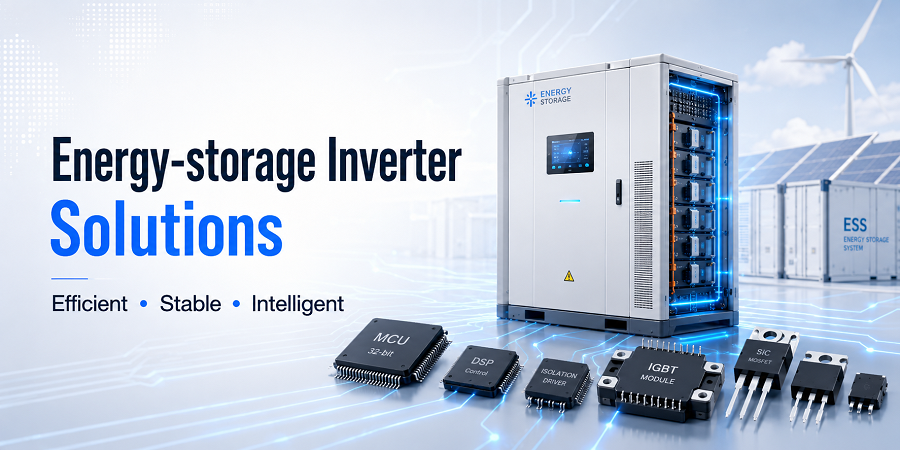
Bidirectional, high-efficiency power-conversion architectures for residential, commercial and industrial energy storage, integrating battery management, DC-link regulation, grid-tied inversion and comprehensive system protection.
Bidirectional conversion for reliable, grid-ready energy storage
Energy storage inverters transfer power between a battery system, a regulated DC link and the AC grid or local load. During charging, the converter controls battery current and voltage while maintaining grid-quality input behavior. During discharge, stored energy is boosted to the DC link and converted into synchronized AC power for self-consumption, backup operation or grid export. The architecture must coordinate battery limits, bidirectional DC/DC control, inverter modulation, islanding detection, thermal management and rapid fault protection across every operating mode.
Key advantages
Bidirectional charge and discharge
High conversion efficiency
Wide battery-voltage support
Stable high-voltage DC link
Low-distortion AC output
Grid synchronization support
Fast backup transition
Accurate current regulation
Battery and inverter protection
Thermal derating capability
Remote telemetry readiness
Scalable system power
Energy storage inverter architecture and product mapping
Bidirectional Energy Storage Architecture
Battery energy, bidirectional DC/DC conversion, DC-link regulation, grid-tied DC/AC inversion and coordinated control for charging, backup and grid-interactive operation.
Tip: Select a block in the diagram or choose a module from the list. On mobile, swipe horizontally to view the full diagram.
Explore the bidirectional energy storage architecture through an interactive block diagram. Select the battery pack, DC/DC converter, DC/AC inverter or controller and protection block to review its design role, key engineering considerations and recommended MOT device categories.
About the solution
Coordinated battery, DC-link and grid conversion across charge and discharge modes
The energy storage inverter links the battery to a stable high-voltage DC bus through a bidirectional DC/DC stage and exchanges power with the AC grid or local loads through a bidirectional inverter bridge. The controller coordinates precharge, soft start, current references, battery limits, grid synchronization, islanding behavior, transfer logic, thermal derating and protection so the system can move safely between charging, self-consumption, backup and export operation.
Scalable for residential storage, commercial peak shaving and industrial backup systems
The same functional platform can support wall-mounted residential batteries, hybrid solar-storage inverters, commercial energy-storage cabinets, microgrids, telecom backup, EV-charging support and industrial peak-shaving systems. Battery voltage, DC-link level, semiconductor rating, switching frequency, cooling method, grid code and communication interface can be scaled to the required power and installation environment.
Semiconductor categories aligned with the battery, converter, inverter and protection paths
Battery contactor drivers and protection MOSFETs, high-current bidirectional DC/DC switches, isolated gate drivers, inverter MOSFETs or IGBTs, current- and voltage-sense devices, digital power controllers, grid-monitoring supervisors, auxiliary-power ICs and communication interfaces provide a practical component platform for efficient and robust energy storage inverter designs.
Coordinated battery, DC-link and grid conversion across charge and discharge modes
The energy storage inverter links the battery to a stable high-voltage DC bus through a bidirectional DC/DC stage and exchanges power with the AC grid or local loads through a bidirectional inverter bridge. The controller coordinates precharge, soft start, current references, battery limits, grid synchronization, islanding behavior, transfer logic, thermal derating and protection so the system can move safely between charging, self-consumption, backup and export operation.
Scalable for residential storage, commercial peak shaving and industrial backup systems
The same functional platform can support wall-mounted residential batteries, hybrid solar-storage inverters, commercial energy-storage cabinets, microgrids, telecom backup, EV-charging support and industrial peak-shaving systems. Battery voltage, DC-link level, semiconductor rating, switching frequency, cooling method, grid code and communication interface can be scaled to the required power and installation environment.
Semiconductor categories aligned with the battery, converter, inverter and protection paths
Battery contactor drivers and protection MOSFETs, high-current bidirectional DC/DC switches, isolated gate drivers, inverter MOSFETs or IGBTs, current- and voltage-sense devices, digital power controllers, grid-monitoring supervisors, auxiliary-power ICs and communication interfaces provide a practical component platform for efficient and robust energy storage inverter designs.
Contact our engineering team
Talk to Engineering Sales
Tell us your operating conditions and volume plan.
Share your target application, electrical requirements, package preference and estimated quantity. Our field application engineers will follow up with the right battery-charging devices and reference designs for your project.
Response from a dedicated FAE within 1 business day