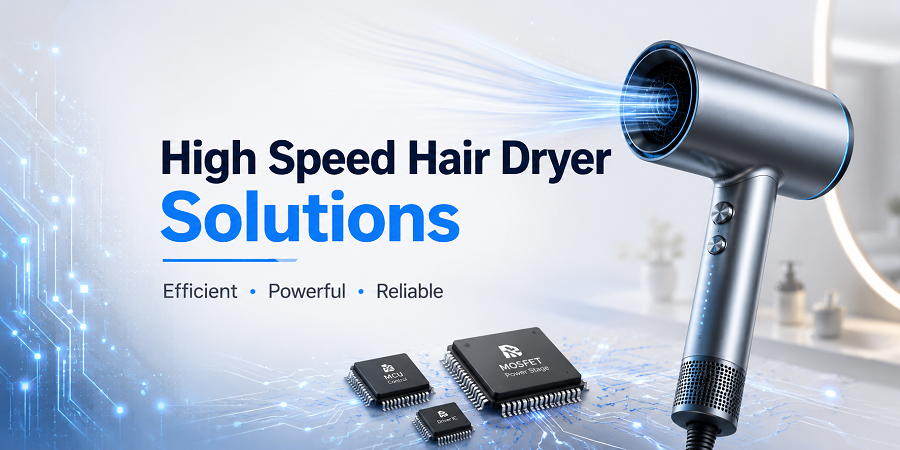
High-efficiency BLDC motor-drive and auxiliary-power semiconductor solutions for compact, powerful and low-noise hair-dryer platforms.
High-speed airflow, precise commutation and compact power conversion for premium hair dryers
High-speed hair dryers use compact BLDC motors operating at very high rotational speed to create strong, controlled airflow with lower acoustic noise and improved energy efficiency. The power platform must convert the rectified mains bus into accurately timed three-phase motor current while maintaining low switching loss, rapid commutation and reliable protection under start-up, stall and airflow-obstruction conditions. A compact auxiliary supply simultaneously provides stable rails for the gate driver, MCU, current sensing, temperature sensing and user interface. Coordinated motor control, airflow feedback and heater regulation help deliver fast drying performance without sacrificing thermal margin, enclosure size or long-term reliability.
Key advantages
High-speed BLDC commutation
Low motor-drive loss
Strong airflow performance
Low acoustic noise
Compact inverter layout
Fast current protection
Stable auxiliary rails
Low standby power
Thermal monitoring support
Controlled heater operation
Wide mains compatibility
High power density
High-speed hair-dryer power architecture and product mapping
BLDC Motor Drive, Heater and Auxiliary Power Architecture
Rectified mains input, three-phase high-speed motor inversion, fan and heater load, low-voltage auxiliary rails, PWM commutation and thermal-feedback coordination.
Tip: Select a block in the diagram or choose a module from the list. On mobile, swipe horizontally to view the full diagram.
Explore the high-speed hair-dryer power architecture through the interactive image map. Select the motor-drive MOSFET or auxiliary power supply to review its electrical role, design priorities and placeholder MOT product mapping.
About the solution
Three-phase MOSFET inversion for high-speed BLDC airflow control
The rectified mains bus feeds a compact three-phase inverter built around low-loss motor-drive MOSFETs. Precisely timed high-side and low-side switching controls the BLDC motor phase currents, rotational speed and torque while minimizing shoot-through, switching loss and audible artifacts. Current limiting, speed feedback and rapid fault turn-off protect the motor and inverter during start-up, blocked airflow or abnormal mechanical loading. A dedicated auxiliary supply provides stable gate-drive and low-voltage control rails without adding unnecessary thermal load to the compact enclosure.
Coordinated airflow, heater regulation and sensor feedback for fast, comfortable drying
High motor speed enables strong airflow from a smaller fan assembly, but the electrical platform must coordinate airflow demand with heater power and outlet-temperature feedback. The control system can reduce heater duty when airflow is restricted, adjust motor speed across user-selected modes and shut down rapidly if current or temperature exceeds the safe operating range. Stable auxiliary rails improve sensor accuracy and control consistency across wide mains voltage, changing ambient conditions and repeated thermal cycles.
Low-loss MOSFETs and compact auxiliary-power devices for dense personal-care electronics
Motor-drive MOSFETs with low RDS(on), optimized gate charge, robust avalanche behavior and thermally efficient packages support high-frequency three-phase commutation. Auxiliary-power MOSFETs, flyback or buck controllers, fast rectifiers, low-quiescent-current regulators and protection devices provide the gate-drive, MCU and sensing rails required by compact high-speed hair-dryer platforms. Device selection can be tuned to the DC-bus voltage, motor phase current, switching frequency, thermal path and standby-power target.
Three-phase MOSFET inversion for high-speed BLDC airflow control
The rectified mains bus feeds a compact three-phase inverter built around low-loss motor-drive MOSFETs. Precisely timed high-side and low-side switching controls the BLDC motor phase currents, rotational speed and torque while minimizing shoot-through, switching loss and audible artifacts. Current limiting, speed feedback and rapid fault turn-off protect the motor and inverter during start-up, blocked airflow or abnormal mechanical loading. A dedicated auxiliary supply provides stable gate-drive and low-voltage control rails without adding unnecessary thermal load to the compact enclosure.
Coordinated airflow, heater regulation and sensor feedback for fast, comfortable drying
High motor speed enables strong airflow from a smaller fan assembly, but the electrical platform must coordinate airflow demand with heater power and outlet-temperature feedback. The control system can reduce heater duty when airflow is restricted, adjust motor speed across user-selected modes and shut down rapidly if current or temperature exceeds the safe operating range. Stable auxiliary rails improve sensor accuracy and control consistency across wide mains voltage, changing ambient conditions and repeated thermal cycles.
Low-loss MOSFETs and compact auxiliary-power devices for dense personal-care electronics
Motor-drive MOSFETs with low RDS(on), optimized gate charge, robust avalanche behavior and thermally efficient packages support high-frequency three-phase commutation. Auxiliary-power MOSFETs, flyback or buck controllers, fast rectifiers, low-quiescent-current regulators and protection devices provide the gate-drive, MCU and sensing rails required by compact high-speed hair-dryer platforms. Device selection can be tuned to the DC-bus voltage, motor phase current, switching frequency, thermal path and standby-power target.
Contact our engineering team
Talk to Engineering Sales
Tell us your operating conditions and volume plan.
Share your target application, electrical requirements, package preference and estimated quantity. Our field application engineers will follow up with the right battery-charging devices and reference designs for your project.
Response from a dedicated FAE within 1 business day