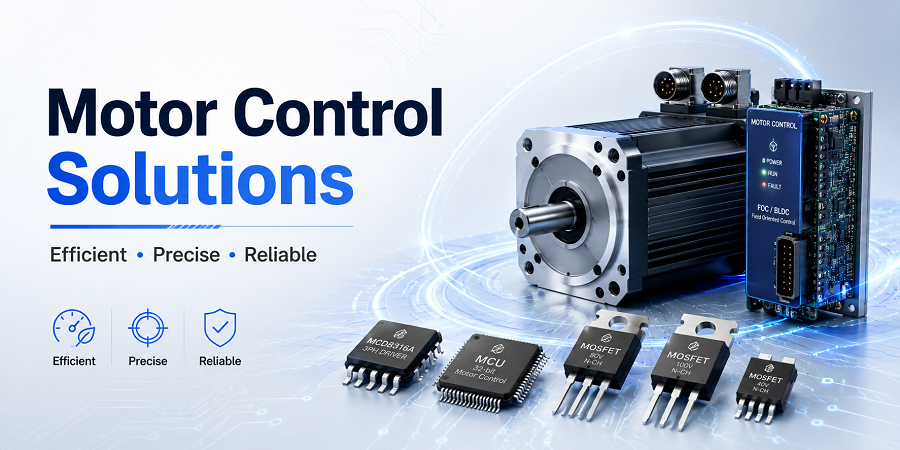
High-efficiency MOSFET power-stage solutions for compact, responsive and thermally robust motor-drive platforms.
Efficient electronic commutation for compact and industrial motor drives
Modern BLDC, PMSM and three-phase motor drives rely on electronically controlled MOSFET half bridges to convert a DC bus into accurately timed phase currents. The electronic-control MOSFET stage must combine low on-resistance, controlled switching charge, robust avalanche behavior and adequate safe-operating-area margin while supporting rapid PWM commutation, regenerative current flow and reliable fault shutdown. Careful device selection improves inverter efficiency, torque response, thermal performance, acoustic behavior and power density across battery-powered and line-powered motor platforms.
Key advantages
Low conduction loss
Fast PWM commutation
High phase-current capability
Low gate charge
Robust avalanche margin
Regenerative current handling
Controlled dead time
Rapid fault shutdown
Compact power packages
Reduced inverter heating
Wide DC-bus compatibility
Scalable motor power
Motor-control power stage and product mapping
Electronic Commutation and Three-Phase Drive Architecture
DC-bus conversion, six-switch three-phase inversion, PWM commutation, regenerative current flow, motor phase drive and coordinated current, speed and position feedback.
Tip: Select the filled MOSFET power-stage block in the diagram or choose it from the list. On mobile, swipe horizontally to view the full diagram.
Explore the motor-control architecture through an interactive image map. Select the Electronic Control MOSFET stage to review its electrical role, key selection criteria and placeholder MOT product mapping.
About the solution
Six-switch MOSFET inversion with coordinated phase-current control
The solution uses three MOSFET half bridges to create the phase voltages required by BLDC, PMSM and other three-phase motors. Complementary high-side and low-side switching, controlled dead time and current feedback allow the system to regulate torque and speed while minimizing shoot-through, switching loss and current ripple. The MOSFET body-diode path and synchronous switching behavior also provide a controlled route for inductive and regenerative current during commutation and braking.
Scalable from compact battery drives to industrial motor platforms
The same power-stage concept can be adapted for pumps, fans, compressors, power tools, robotics, e-mobility auxiliaries, home appliances, automation equipment and servo mechanisms. MOSFET voltage rating, current capability, package thermal resistance, switching frequency and parallel-device count can be selected to match the DC bus, phase current, motor inductance, duty cycle, enclosure cooling and control strategy.
Electronic-control MOSFET candidates aligned with inverter efficiency and reliability targets
Low-voltage and medium-voltage N-channel MOSFETs with low RDS(on), optimized gate charge, controlled reverse-recovery behavior, strong avalanche capability and thermally efficient packages provide a practical foundation for half-bridge and three-phase inverter stages. Device selection can be optimized for battery-fed compact drives, higher-voltage industrial buses, high-frequency PWM operation or demanding transient-current conditions.
Six-switch MOSFET inversion with coordinated phase-current control
The solution uses three MOSFET half bridges to create the phase voltages required by BLDC, PMSM and other three-phase motors. Complementary high-side and low-side switching, controlled dead time and current feedback allow the system to regulate torque and speed while minimizing shoot-through, switching loss and current ripple. The MOSFET body-diode path and synchronous switching behavior also provide a controlled route for inductive and regenerative current during commutation and braking.
Scalable from compact battery drives to industrial motor platforms
The same power-stage concept can be adapted for pumps, fans, compressors, power tools, robotics, e-mobility auxiliaries, home appliances, automation equipment and servo mechanisms. MOSFET voltage rating, current capability, package thermal resistance, switching frequency and parallel-device count can be selected to match the DC bus, phase current, motor inductance, duty cycle, enclosure cooling and control strategy.
Electronic-control MOSFET candidates aligned with inverter efficiency and reliability targets
Low-voltage and medium-voltage N-channel MOSFETs with low RDS(on), optimized gate charge, controlled reverse-recovery behavior, strong avalanche capability and thermally efficient packages provide a practical foundation for half-bridge and three-phase inverter stages. Device selection can be optimized for battery-fed compact drives, higher-voltage industrial buses, high-frequency PWM operation or demanding transient-current conditions.
Contact our engineering team
Talk to Engineering Sales
Tell us your operating conditions and volume plan.
Share your target application, electrical requirements, package preference and estimated quantity. Our field application engineers will follow up with the right battery-charging devices and reference designs for your project.
Response from a dedicated FAE within 1 business day