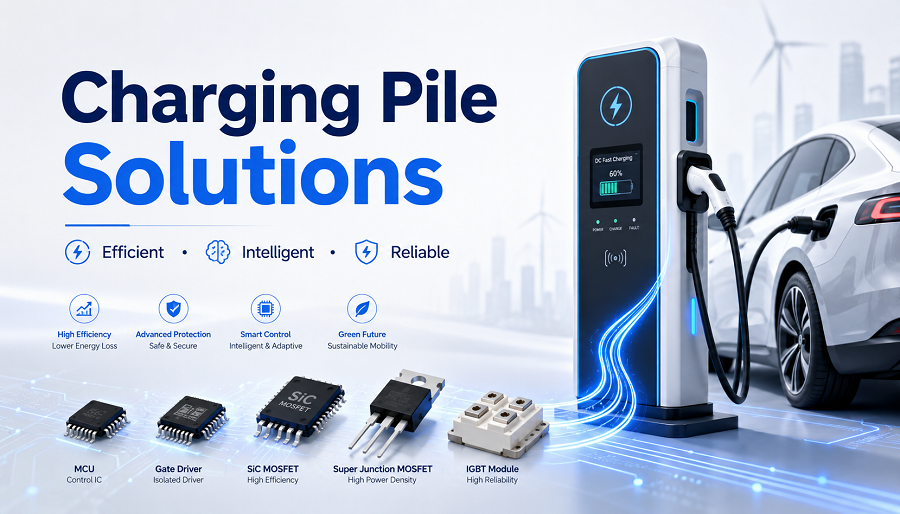
High-efficiency power-conversion solutions for EV charging piles and DC fast chargers, integrating active PFC, isolated high-voltage DC/DC conversion, low-loss secondary rectification, auxiliary power and digital telemetry.
Scalable isolated power conversion for reliable EV charging infrastructure
Charging piles convert three-phase or single-phase utility power into a controlled high-voltage DC output for electric-vehicle batteries. A practical architecture combines input filtering and active power-factor correction, an isolated high-voltage DC/DC primary stage, efficient secondary rectification, stable auxiliary rails and a digital controller that coordinates charging profiles, protection, metering and remote communication. These functions must work together across wide line conditions, changing battery voltage, high output current and demanding thermal environments while maintaining safety isolation and predictable service operation.
Key advantages
High input power factor
Low input current THD
Wide EV battery-voltage support
High conversion efficiency
Galvanic isolation
High power density
Low secondary conduction loss
Fast charge-profile response
Accurate voltage and current control
Comprehensive fault protection
Remote telemetry readiness
Scalable modular charger power
Charging pile architecture and product mapping
EV Charging Pile Power Architecture
AC input conditioning, active PFC, isolated high-voltage DC/DC conversion, low-loss secondary rectification, protected DC output, auxiliary power and digital telemetry.
Tip: Select a block in the diagram or choose a module from the list. On mobile, swipe horizontally to view the full diagram.
Explore the charging-pile power architecture through the interactive block diagram. Select PFC, the isolated HV DC/DC primary stage, secondary rectifier, auxiliary power or digital controller and telemetry block to review its design role, key engineering considerations and placeholder MOT device mapping.
About the solution
Modular isolated conversion with coordinated charging control and service telemetry
The charging pile shapes and rectifies the utility input, establishes a stable high-voltage DC bus and transfers energy through an isolated DC/DC stage to the vehicle-side output. High-current secondary rectification and filtering provide the commanded battery voltage and current, while auxiliary supplies support control, gate-drive, metering and communication circuits. The digital controller coordinates startup, power-module sharing, charging profiles, contactor control, protection and remote diagnostics.
Adaptable for public DC fast chargers, fleet depots and destination charging infrastructure
The same functional platform can be scaled from compact integrated charging piles to modular high-power cabinets. Designers can adapt the number of power modules, input phase configuration, output-voltage range, cooling system, communication interface and payment or cloud platform to support passenger vehicles, commercial fleets, buses, logistics depots and mixed charging sites.
Semiconductor building blocks aligned with every critical charger power and control stage
PFC switches and controllers, high-voltage primary MOSFETs, resonant and phase-shift controllers, isolated gate drivers, secondary rectifier devices, auxiliary-power ICs, sensing and protection components, digital controllers and communication-interface devices form a practical platform for efficient, maintainable and scalable charging-pile designs.
Modular isolated conversion with coordinated charging control and service telemetry
The charging pile shapes and rectifies the utility input, establishes a stable high-voltage DC bus and transfers energy through an isolated DC/DC stage to the vehicle-side output. High-current secondary rectification and filtering provide the commanded battery voltage and current, while auxiliary supplies support control, gate-drive, metering and communication circuits. The digital controller coordinates startup, power-module sharing, charging profiles, contactor control, protection and remote diagnostics.
Adaptable for public DC fast chargers, fleet depots and destination charging infrastructure
The same functional platform can be scaled from compact integrated charging piles to modular high-power cabinets. Designers can adapt the number of power modules, input phase configuration, output-voltage range, cooling system, communication interface and payment or cloud platform to support passenger vehicles, commercial fleets, buses, logistics depots and mixed charging sites.
Semiconductor building blocks aligned with every critical charger power and control stage
PFC switches and controllers, high-voltage primary MOSFETs, resonant and phase-shift controllers, isolated gate drivers, secondary rectifier devices, auxiliary-power ICs, sensing and protection components, digital controllers and communication-interface devices form a practical platform for efficient, maintainable and scalable charging-pile designs.
Contact our engineering team
Talk to Engineering Sales
Tell us your operating conditions and volume plan.
Share your target application, electrical requirements, package preference and estimated quantity. Our field application engineers will follow up with the right battery-charging devices and reference designs for your project.
Response from a dedicated FAE within 1 business day