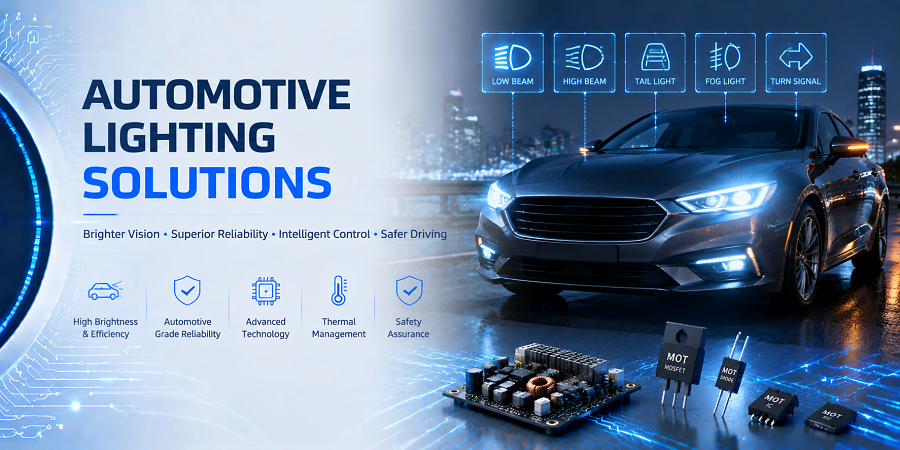
Robust discrete-semiconductor solutions for exterior and interior vehicle lighting, supporting reverse-battery protection, efficient current paths, PWM dimming, diagnostics and reliable LED operation across demanding automotive electrical conditions.
Protected and efficient semiconductor paths for modern vehicle lighting
Automotive lighting electronics must operate from a noisy 12 V or 24 V vehicle bus while surviving reverse-battery connection, jump-start conditions, load-dump transients and repeated thermal cycling. A practical lighting architecture combines a protected vehicle-power input, reverse-polarity MOSFET control, a regulated LED-driver stage, Schottky rectification or clamping paths and BJT devices for signal conditioning, current control, diagnostics or small-load switching. These building blocks help designers maintain stable LED current, low conduction loss, predictable dimming and dependable fault behavior in headlamps, daytime-running lights, rear lamps, turn indicators and interior lighting modules.
Key advantages
Reverse-battery protection
Low forward-path loss
Fast transient steering
Stable LED current
Accurate PWM dimming
Low thermal rise
Compact discrete-device footprint
Automotive input robustness
Fault and open-load diagnostics
Reliable cold-crank operation
Scalable exterior and interior lighting
Support for multi-channel lamp modules
Automotive lighting architecture and product mapping
Automotive Lighting Power Architecture
Vehicle-bus input protection, regulated LED driving, Schottky steering and BJT control functions for exterior and interior automotive lighting loads.
Tip: Select a block in the diagram or choose a module from the list. On mobile, swipe horizontally to view the full diagram.
Explore the automotive-lighting power architecture through the interactive block diagram. Select Reverse Polarity Protection, Schottky Diode or BJT Products to review each function, key engineering considerations and placeholder MOT device mapping.
About the solution
Protected vehicle-bus entry, controlled LED current and diagnostic signal handling
The vehicle battery first passes through input filtering and a low-loss reverse-polarity protection stage before feeding the LED-driver power path. The driver regulates current for the lamp load, while Schottky diodes support freewheel, clamp, steering or ORing positions with low forward drop and fast response. BJT devices can provide level shifting, current amplification, signal conditioning, diagnostic pull-downs and compact switching functions around the control and lamp-monitoring circuits.
Scalable across headlamps, daytime-running lights, rear lamps and interior illumination
The same discrete-device functions can be adapted for exterior high-power LED modules, compact signal lamps, turn indicators, fog lamps, license-plate lighting, ambient interior lighting and dashboard illumination. Voltage rating, pulse-current capability, reverse leakage, thermal package performance and diagnostic strategy can be selected according to lamp power, channel count, enclosure temperature and vehicle electrical requirements.
Device categories aligned with protection, rectification, control and diagnostic paths
Low-RDS(on) MOSFETs for reverse-battery protection, low-forward-voltage Schottky diodes for steering and freewheel paths, and compact NPN or PNP BJT products for interfaces, level shifting, current drive and diagnostics provide a practical discrete-semiconductor platform for reliable automotive lighting modules.
Protected vehicle-bus entry, controlled LED current and diagnostic signal handling
The vehicle battery first passes through input filtering and a low-loss reverse-polarity protection stage before feeding the LED-driver power path. The driver regulates current for the lamp load, while Schottky diodes support freewheel, clamp, steering or ORing positions with low forward drop and fast response. BJT devices can provide level shifting, current amplification, signal conditioning, diagnostic pull-downs and compact switching functions around the control and lamp-monitoring circuits.
Scalable across headlamps, daytime-running lights, rear lamps and interior illumination
The same discrete-device functions can be adapted for exterior high-power LED modules, compact signal lamps, turn indicators, fog lamps, license-plate lighting, ambient interior lighting and dashboard illumination. Voltage rating, pulse-current capability, reverse leakage, thermal package performance and diagnostic strategy can be selected according to lamp power, channel count, enclosure temperature and vehicle electrical requirements.
Device categories aligned with protection, rectification, control and diagnostic paths
Low-RDS(on) MOSFETs for reverse-battery protection, low-forward-voltage Schottky diodes for steering and freewheel paths, and compact NPN or PNP BJT products for interfaces, level shifting, current drive and diagnostics provide a practical discrete-semiconductor platform for reliable automotive lighting modules.
Contact our engineering team
Talk to Engineering Sales
Tell us your operating conditions and volume plan.
Share your target application, electrical requirements, package preference and estimated quantity. Our field application engineers will follow up with the right battery-charging devices and reference designs for your project.
Response from a dedicated FAE within 1 business day