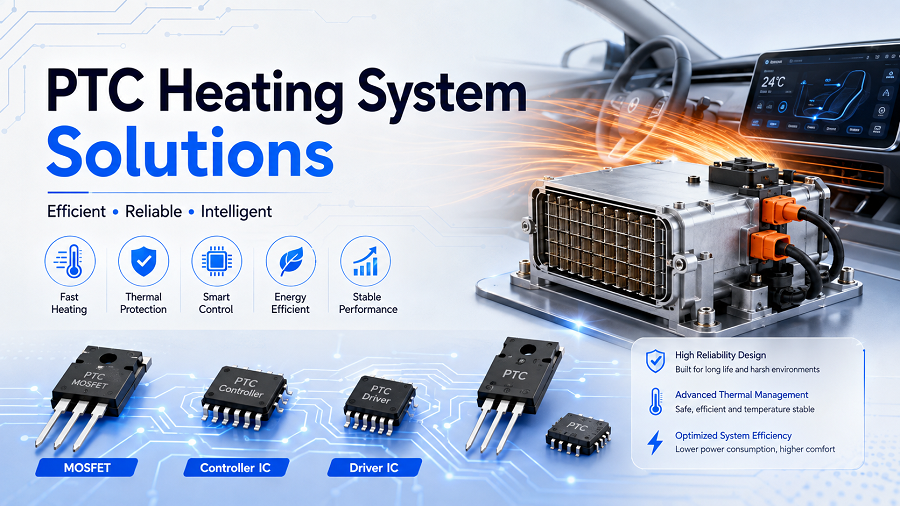
High-current semiconductor switching solutions for automotive PTC heaters, enabling controlled cabin, battery and coolant heating with efficient bus isolation, load management and fault protection.
Controlled high-voltage switching for efficient automotive PTC thermal management
PTC heating systems provide rapid, self-regulating heat for electric and hybrid vehicles when waste heat from the powertrain is limited. A protected high-voltage battery bus feeds the heater through a VBUS isolation switch and a dedicated main load switch. The upstream switch controls connection to the vehicle DC bus, while the load switch manages heater energization, current limiting, fault isolation and coordinated shutdown. This architecture supports dependable cabin heating, battery preconditioning and coolant heating across cold-start, transient-load and diagnostic operating conditions.
Key advantages
Fast cold-start heating
High-current bus capability
Low conduction loss
Controlled inrush current
High-voltage load isolation
Short-circuit protection
Overtemperature shutdown
Accurate load control
Diagnostic feedback support
Compact thermal design
Automotive transient robustness
Scalable heater power
PTC heating architecture and product mapping
Automotive PTC Heating Architecture
High-voltage battery input, VBUS isolation, main heater-load switching, thermal feedback and coordinated HVAC control.
Tip: Select a block in the diagram or choose a module from the list. On mobile, swipe horizontally to view the full diagram.
Explore the PTC heating power path through the interactive block diagram. Select the VBUS bus switch or main load switch to review its role in high-voltage isolation, heater-current management, protection and placeholder MOT device mapping.
About the solution
Two-stage high-voltage switching separates bus isolation from heater-load control
The VBUS switch provides the controlled connection between the vehicle battery bus and the PTC subsystem, supporting precharge coordination, safe disconnect and diagnostic isolation. The main load switch then energizes the heater element and manages current under HVAC or vehicle-control commands. Current, voltage and temperature feedback allow the controller to derate or shut down the load when abnormal operating conditions are detected.
Designed for cabin heating, battery preconditioning and electric coolant heaters
The architecture can be adapted to air-heater and liquid-heater assemblies used in battery-electric, plug-in hybrid and commercial electric vehicles. Power-device selection is driven by heater power, bus voltage, switching strategy, allowable voltage drop, cold-start current and the thermal path available inside the heater control unit.
High-current MOSFET switching, gate control, sensing and protection for PTC loads
Low-resistance automotive MOSFETs, high-side and low-side gate drivers, current-sense devices, voltage supervisors, transient-protection diodes and temperature-monitoring components provide the semiconductor foundation for compact, efficient and diagnosable PTC heating modules.
Two-stage high-voltage switching separates bus isolation from heater-load control
The VBUS switch provides the controlled connection between the vehicle battery bus and the PTC subsystem, supporting precharge coordination, safe disconnect and diagnostic isolation. The main load switch then energizes the heater element and manages current under HVAC or vehicle-control commands. Current, voltage and temperature feedback allow the controller to derate or shut down the load when abnormal operating conditions are detected.
Designed for cabin heating, battery preconditioning and electric coolant heaters
The architecture can be adapted to air-heater and liquid-heater assemblies used in battery-electric, plug-in hybrid and commercial electric vehicles. Power-device selection is driven by heater power, bus voltage, switching strategy, allowable voltage drop, cold-start current and the thermal path available inside the heater control unit.
High-current MOSFET switching, gate control, sensing and protection for PTC loads
Low-resistance automotive MOSFETs, high-side and low-side gate drivers, current-sense devices, voltage supervisors, transient-protection diodes and temperature-monitoring components provide the semiconductor foundation for compact, efficient and diagnosable PTC heating modules.
Contact our engineering team
Talk to Engineering Sales
Tell us your operating conditions and volume plan.
Share your target application, electrical requirements, package preference and estimated quantity. Our field application engineers will follow up with the right battery-charging devices and reference designs for your project.
Response from a dedicated FAE within 1 business day