Server Solutions

High-current motherboard busbar switching solutions for efficient power-path control, controlled startup and dependable fault isolation in modern server platforms.

Server motherboard power-distribution application

Controlled high-current power delivery from the server busbar to the motherboard

Modern servers distribute substantial power from redundant AC/DC power supplies through a 12 V or 48 V intermediate bus and into motherboard voltage-regulator stages serving CPUs, GPUs, memory, storage and network devices. The motherboard busbar power switch controls this high-current connection during startup, service insertion and fault events. A practical implementation combines very low-resistance power MOSFETs with hot-swap or electronic-fuse control, current sensing, inrush limiting, reverse-current management and fast protection. Device selection must balance conduction loss, current-sharing stability, safe operating area, gate charge, transient capability, package thermal performance and the mechanical constraints of dense server power planes.

Key advantages

  • Low busbar conduction loss
  • Controlled inrush current
  • Fast overcurrent isolation
  • Hot-swap power-path control
  • Reverse-current management
  • High continuous-current capability
  • Strong safe operating area
  • Accurate current monitoring
  • Fault reporting to the BMC
  • Redundant-power compatibility
  • Thermal-aware derating
  • Scalable 12 V / 48 V architecture

Server motherboard power architecture and product mapping

Server Motherboard Power Distribution Architecture

Redundant PSU input, high-current busbar switching, controlled startup, fault isolation and motherboard power distribution.

Server Solutions Editable two-to-one SVG block diagram for server power distribution. The interactive MOT-supported module is the Motherboard Busbar Power Switch. SERVER SOLUTIONS Redundant Server PSU & DC Bus 12 V / 48 V intermediate power rail Motherboard Busbar Power Switch I SENSELow-RDS(on) MOSFET array · hot-swap control · current sensing · fault isolation CPU GPU VRM Motherboard Power Planes & Compute Loads CPU · GPU · memory · storage · network controllers 12 V / 48 V BUS SWITCHED BUS BMC ENABLE · CURRENT TELEMETRY · POWER-GOOD · FAULT REPORTING The busbar switch limits insertion current, minimizes distribution loss and isolates motherboard faults from the shared server power rail. Filled blocks: MOT supported device candidates Outline blocks: necessary system functions MOT Semiconductor Solutions
Tip: Select a block in the diagram or choose a module from the list. On mobile, swipe horizontally to view the full diagram.

Explore the server motherboard power architecture through the interactive block diagram. Select Motherboard Busbar Power Switch to review its electrical role, power-path priorities and placeholder MOT device mapping.

About the solution

High-current hot-swap control between the redundant PSU bus and motherboard power planes

The motherboard busbar power switch sits between the shared server DC rail and the local motherboard distribution network. During board insertion or system startup, the controller ramps the MOSFET array to limit inrush into bulk capacitance. In normal operation, very low path resistance minimizes losses at hundreds of amperes. During short-circuit, overload, reverse-current or thermal events, the switch isolates the motherboard and reports status to the baseboard management controller. Parallel MOSFET layout, current sharing, gate-drive control and safe operating area are therefore central design considerations.

Applicable to rack servers, AI accelerators, storage nodes and network appliances

High-current switched busbars are used in cloud-computing servers, GPU and AI accelerator trays, storage systems, telecom and networking equipment, modular compute sleds and other serviceable platforms with redundant power supplies. System voltage, peak load current, bulk capacitance, insertion requirements, redundancy strategy, allowable voltage drop, airflow and board temperature determine the required MOSFET count, package type and protection thresholds.

Low-resistance power MOSFETs, hot-swap control, sensing and protection for dense server systems

The semiconductor platform may include low-voltage power MOSFETs, dual or multi-chip power packages, hot-swap and electronic-fuse controllers, current-sense amplifiers, transient suppressors, gate drivers and temperature-monitoring devices. Final component selection should be validated against continuous bus current, insertion energy, fault interruption time, parallel-device current balance, copper and busbar resistance, airflow and worst-case junction temperature.

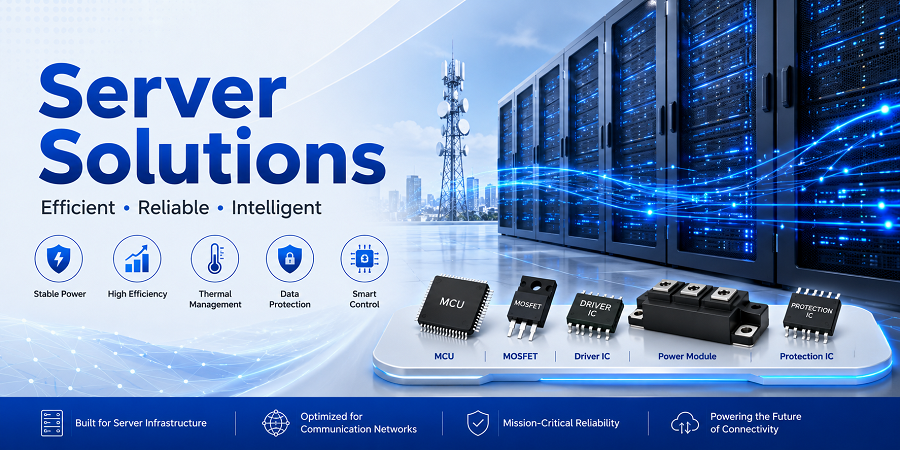
High-current hot-swap control between the redundant PSU bus and motherboard power planes

The motherboard busbar power switch sits between the shared server DC rail and the local motherboard distribution network. During board insertion or system startup, the controller ramps the MOSFET array to limit inrush into bulk capacitance. In normal operation, very low path resistance minimizes losses at hundreds of amperes. During short-circuit, overload, reverse-current or thermal events, the switch isolates the motherboard and reports status to the baseboard management controller. Parallel MOSFET layout, current sharing, gate-drive control and safe operating area are therefore central design considerations.

Applicable to rack servers, AI accelerators, storage nodes and network appliances

High-current switched busbars are used in cloud-computing servers, GPU and AI accelerator trays, storage systems, telecom and networking equipment, modular compute sleds and other serviceable platforms with redundant power supplies. System voltage, peak load current, bulk capacitance, insertion requirements, redundancy strategy, allowable voltage drop, airflow and board temperature determine the required MOSFET count, package type and protection thresholds.

Low-resistance power MOSFETs, hot-swap control, sensing and protection for dense server systems

The semiconductor platform may include low-voltage power MOSFETs, dual or multi-chip power packages, hot-swap and electronic-fuse controllers, current-sense amplifiers, transient suppressors, gate drivers and temperature-monitoring devices. Final component selection should be validated against continuous bus current, insertion energy, fault interruption time, parallel-device current balance, copper and busbar resistance, airflow and worst-case junction temperature.

Contact our engineering team

Talk to Engineering Sales

Tell us your operating conditions and volume plan.

Share your target application, electrical requirements, package preference and estimated quantity. Our field application engineers will follow up with the right battery-charging devices and reference designs for your project.

  • Response from a dedicated FAE within 1 business day
  • Free samples available for qualified design-ins
  • NDA-protected review for early-stage projects
Contact Form