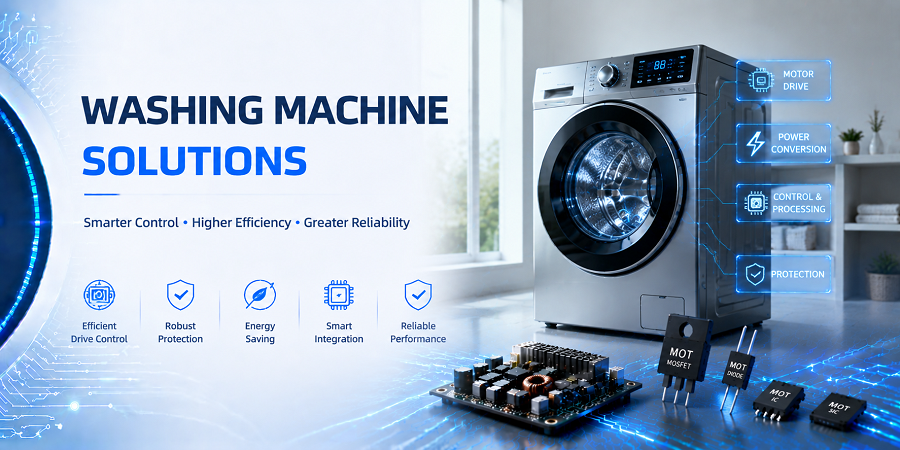
Efficient semiconductor solutions for inverter washing machines, integrating input power-factor correction, three-phase drum-motor control, auxiliary power distribution and intelligent MCU-based cycle management.
High-efficiency power conversion and precise motor control for modern washing machines
Inverter washing machines must combine low standby consumption, controlled input current, quiet drum operation and dependable torque across wash, rinse and high-speed spin cycles. A practical architecture uses a front-end PFC stage to regulate the DC bus, a three-phase inverter to drive a BLDC or PMSM drum motor, an auxiliary supply for logic and cooling loads, and an MCU-based controller with gate driving, sensing and protection. Coordinated control of these blocks enables smooth acceleration, accurate speed regulation, unbalanced-load handling, efficient water extraction and reliable operation under changing mains, load and temperature conditions.
Key advantages
High motor-drive efficiency
Improved input power factor
Quiet low-speed drum control
Fast high-speed spin response
Smooth startup and braking
Reduced switching and conduction loss
Stable auxiliary power rails
Accurate current and speed feedback
Unbalanced-load detection support
Overcurrent and thermal protection
Lower standby power
Scalable appliance-control platform
Washing machine power architecture and product mapping
Washing Machine Inverter Architecture
AC input conditioning, PFC-regulated DC bus, three-phase drum-motor inversion, auxiliary power and MCU-based appliance control.
Tip: Select a block in the diagram or choose a module from the list. On mobile, swipe horizontally to view the full diagram.
Explore the washing-machine power architecture through the interactive block diagram. Select PFC, Three-Phase Inverter, Auxiliary Power & Fan or MCU Controller & Driver to review each function, key engineering considerations and placeholder MOT device mapping.
About the solution
Coordinated PFC, three-phase motor inversion and appliance-level digital control
The AC input is filtered and rectified before the PFC stage regulates the high-voltage DC bus. A three-phase inverter then supplies the BLDC or PMSM drum motor, while an auxiliary converter powers the controller, sensing circuits, valves, user interface and cooling functions. The MCU and driver stage coordinates PWM generation, current sampling, speed regulation, braking, water-level logic, door-lock status and fault shutdown throughout the appliance operating sequence.
Optimized control across wash, rinse, distribution and high-speed spin modes
Low-speed wash motion requires smooth torque and quiet reversing, whereas spin extraction demands rapid acceleration, stable high-speed operation and careful handling of unbalanced loads. The same control platform can also supervise drain pumps, inlet valves, cooling fans and other auxiliary loads, helping manufacturers improve energy efficiency, acoustic performance, cycle consistency and protection behavior across different drum sizes and regional mains conditions.
Semiconductor building blocks aligned with input power, motor drive and appliance supervision
PFC MOSFETs and diodes, inverter power switches, high-side and low-side gate drivers, current-sensing and protection ICs, auxiliary power-management devices, fan and valve load switches, MCU or DSP controllers and interface components form a practical product platform for efficient, quiet and reliable inverter washing-machine designs.
Coordinated PFC, three-phase motor inversion and appliance-level digital control
The AC input is filtered and rectified before the PFC stage regulates the high-voltage DC bus. A three-phase inverter then supplies the BLDC or PMSM drum motor, while an auxiliary converter powers the controller, sensing circuits, valves, user interface and cooling functions. The MCU and driver stage coordinates PWM generation, current sampling, speed regulation, braking, water-level logic, door-lock status and fault shutdown throughout the appliance operating sequence.
Optimized control across wash, rinse, distribution and high-speed spin modes
Low-speed wash motion requires smooth torque and quiet reversing, whereas spin extraction demands rapid acceleration, stable high-speed operation and careful handling of unbalanced loads. The same control platform can also supervise drain pumps, inlet valves, cooling fans and other auxiliary loads, helping manufacturers improve energy efficiency, acoustic performance, cycle consistency and protection behavior across different drum sizes and regional mains conditions.
Semiconductor building blocks aligned with input power, motor drive and appliance supervision
PFC MOSFETs and diodes, inverter power switches, high-side and low-side gate drivers, current-sensing and protection ICs, auxiliary power-management devices, fan and valve load switches, MCU or DSP controllers and interface components form a practical product platform for efficient, quiet and reliable inverter washing-machine designs.
Contact our engineering team
Talk to Engineering Sales
Tell us your operating conditions and volume plan.
Share your target application, electrical requirements, package preference and estimated quantity. Our field application engineers will follow up with the right battery-charging devices and reference designs for your project.
Response from a dedicated FAE within 1 business day