& V: Guaranteed system security redundancy
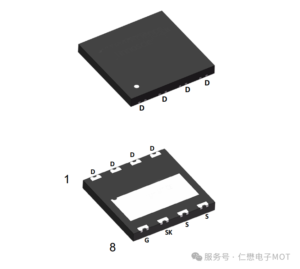
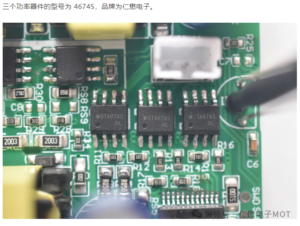
MOT4674S N ditch V = 40V, P ditch V = 40V, which is significantly higher than the main motor (12V/24V). When the fan lights are activated, slot switching or voltage voltage fluctuations, the electrical circuits generate an induction voltage peak, with 40V tolerance values providing sufficient safety redundancy of 16V ~28V, effectively avoiding the tipping of the voltage caps to MOSFET, and ensuring stability of the triple-bridge-driven circuits under dynamic conditions. At the same time, the V (bracket voltage) parameters for ±20V can be directly adapted to the 5V/10V grid-driven circuits commonly used in fan lamps, without the need for additional fence-pressure forceplugs, to simplify driver design and reduce cost.
& Electricity parameter: Match fan power output to shock load demand
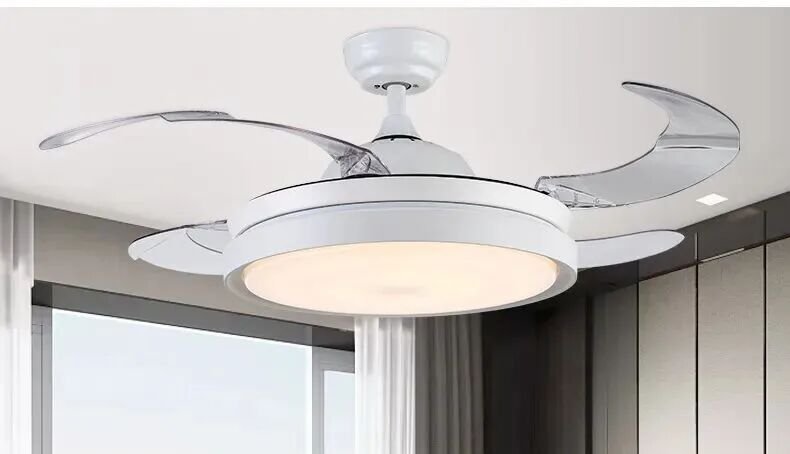
N Trench channels continue to leak polar currents I = 7A, P ditch I = 5A, pulse leaking polar currents I (N Tunnel 28A, P Tunnel 20A) far beyond routine working power of fan light generators (0. 8A ~ 3A) and activation of peak currents (6A). (b) The pulse current capacity of 28A can easily cope with shock currents when the power is activated and avoid activation failure, vibration or overheating of the device.
& R: Reduce lead losses and improve system efficiency
The typical R values for the MOT4674S N channel are only 24 m at V=10V, I=5A; V=4. 5V, I=5A at 32m; and P =10V, I=5A at 54m. As long-term household electricity, the energy efficiency directly affects the user ' s cost of use (market power consumption) or the continuation of the flight (charged windlight). Low-conductive loss and loss can reduce electrical energy to thermal energy by increasing energy efficiency on the one hand, and reducing the temperature of the drive plate and the design requirements of the dispersing heat system on the other.
Switch properties (t, t, Q): Fit PWM velocity to increase control accuracy and silent effect
MOT4674S N ditch opening delay t= 4. 5ns, break delay t= 14. 5ns, uptime t= 2. 5ns, downtime t= 3. 5ns; grid charge Q= 8. 9nC (N ditch), 17nC (P ditch). A fan lamp needs to support multi-steal velocity (e. g. 3 ~6 ) and mainstream the PWM velocity frequency of 20 kHz ~ 25 kHz to avoid smellable noise. Short switch delays ensure that the switch is accurate and avoids twisting fluctuations and running noise due to delay; low grid charge reduces the loss of grid-driven circuits, while increasing the speed of switch response, smoothing the fan light slots to smoother (no-turn speed mutations), higher PWM modulation and more stable (no-diveness).
Summarize
From the FAE professional point of view, the core parameters of MOT4674S (high resistance, sufficient current redundancy, low loss, fast switches, small envelopes) correspond to the demand of the BLDC drive system. Its core advantage is that “high-reliability redundancy + low-depletion energy efficiency + high-integral compatibility” directly enhances the four core indicators of ventilation, energy efficiency, silent effects and stability of fans, while simplifying driver programme design, reducing R & D and post-sales costs, and enabling products to be certified through home electricity compliance. In addition, the low EMI and environmental characteristics of the device further align with the trend towards “efficient, silent, environmentally friendly” modern household electricity, which is the preferred MOSFET device for the fan light drive system.