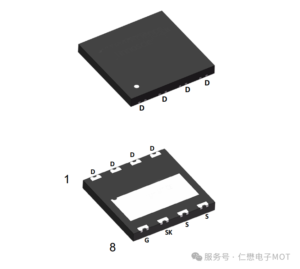
Advantage of application of Mot60N03F MOS parameters in PC power supply
Technical Application Analysis

Voltage parameters (V = 30V, V = ± 20V): Fit low-pressure side-voltage environment, secure sufficiency
The range of critical chain voltage on the lower voltage side of the PC power is clear: the synchronous whole-flow chain corresponds to the 12V output track, with a peak of approximately 15V after the current; the input voltage of the pressure-relief chain of 3. 3V/5V DC-DC is 12V, with an output voltage of 3. 3V/5V, and the maximum voltage of the device does not exceed 18V (attracted peak). MOT60N03F ' s V = 30V (minimal value) is effective in inhibiting the risk of a perusal blow-off and avoiding failure of the device by placing more than 67% of the voltage on the actual working voltage.
Current parameters (I = 60A, I = 240A): Loading large current loads in response to transient shocks
Current currents of the modern PC 12V output track generally reach 30 ~ 166. 5A (e. g. Kage 2000W 12V output 166. 5A). Synchronization of the current chain usually involves multiple MOSFETs and splits, with a single device carrying a continuous current of 15-25A; continuous currents of up to 30A in 3. 3V/5V output track I = 60A (25°C) in a single MOT60N03F can fully cover single-circuit output needs, even in a high temperature environment (100°C) to carry 38A power currents to meet the long-term running needs of the full-load power load.
More importantly, PC power can produce instant current peaks (e. g. , up to 80-150A at the peak of the 12V track) in a fully loaded, ultra-frequency scenario such as GPU/CPU, which MOTAPM60N03F I = 240A (short-time pulse current) can easily withstand, combined with its 120 mJ avalanche energy (E), which can effectively absorb peak energy, avoid transient burning and increase power resistance to shocks.
Export characteristics (9 m)
The consumption of PC power mainly consists of the loss of conductivity and switch, with low-pressure large current conductivity transport accounting for over 60 per cent (P=I2R). MoOT60N03F at V = 10V, I = 20A, the typical R value is only 7. 7 m, with a maximum value of 9 m, much better than the same low pressure MOSFETs.
Temperature and dissipation properties (T=150°C, R=4. 17°C/W): Fit for high temperature environment
The interior space of the PC power is compact, with MOSFETs adjacent to heaters such as transformers, sensors, etc. , at working temperatures of up to 80 ~ 100 °C. MOT60N03F has a temperature range of -55 ~150°C, which does not exceed the safety limit even in a high-temperature cumulative scenario (e. g. , two hours of continuous power load). Its crusts = 4. 17°C/W, combined with TO-220F envelopes (the size of the dispersive heat area, which allows for the adhesion of thermal pads), can quickly leave the tropics and reduce the temperature of the apparatus.
Body diode properties (t = 30ns, Q = 25nC): Optimization of synchronized whole flow
The MOSFETs diodes are required to perform continuity functions in the PPC synchronous current cycle, and the smaller the reverse recovery time (t) and the reverse recovery charge (Q), the lower the reverse recovery loss. MOT60N03F = t = 30ns, Q = 25nC (typical value), which is much better than the traditional Shortki diode (t usually > 100ns), can effectively reduce energy losses during continuity and further improve the efficiency of synchronized current consolidation, while reducing the peak of voltage generated by reverse recovery.
Summary
MOT60N03F's low-pressure large current parameters (30V/60A), low-depletion properties (7. 7m R, 42nC Q), excellent switches and temperature properties are precise enough to match the application needs of PC's low-pressure side synchronized currents, DC-DC relief and load switches. Its core advantages are high reliability, efficient energy efficiency, streamlined design and environmentally compatible, which directly enhances the efficiency of the conversion of the PC power supply, the stability of the power supply, and its load adaptability, while reducing the heat, noise and recovery rates and extending its useful life. From the FAE engineering perspective, the further performance of the device and the avoidance of the application risk can be further enhanced by a reasonable grid-protected, dissipation optimization, which is a high value-for-money option for the MOSFETs on the low pressure side of the PC power source.