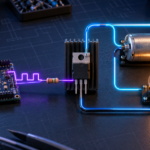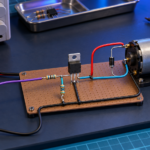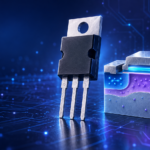
Is a MOSFET a transistor? Yes. A MOSFET is a type of field-effect transistor that uses voltage at an insulated gate to control current between drain and source. Its full name is metal-oxide-semiconductor field-effect transistor.
MOSFETs belong to the broad transistor family alongside bipolar junction transistors, JFETs, and IGBTs. They are used as electronic switches, amplifiers, current regulators, logic elements, and power-control devices.
What makes a device a transistor?
A transistor is a semiconductor device in which one electrical signal controls another current or voltage. It can amplify a signal or operate as an electronic switch. The exact control method depends on the transistor family.
A MOSFET uses an electric field. A BJT uses base current and carrier injection. An IGBT combines an insulated MOS gate with a bipolar conduction structure. Each is a transistor, but their terminals, drive requirements, and performance differ.
Where MOSFETs fit in the transistor family
| Family | Control input | Main terminals | Typical strengths |
|---|---|---|---|
| MOSFET | Gate-to-source voltage | Gate, drain, source | Fast switching, high input resistance, low-voltage efficiency |
| JFET | Gate junction voltage | Gate, drain, source | Low noise, analog input stages, normally-on options |
| BJT | Base current | Base, collector, emitter | High transconductance, analog gain, low saturation voltage in some uses |
| IGBT | Gate-to-emitter voltage | Gate, collector, emitter | High-voltage and high-power switching |
How a MOSFET transistor works
The gate is separated from the semiconductor by a thin dielectric. Gate-to-source voltage creates an electric field that changes the conductivity of a channel between drain and source.
In a common enhancement-mode N-channel MOSFET, the device is normally off at VGS = 0 V. A positive gate voltage begins forming a channel near the threshold. Increasing VGS strengthens the channel and reduces its resistance.
A P-channel MOSFET operates with opposite polarity. It turns on when the gate becomes sufficiently negative relative to the source.
Why a MOSFET is called voltage controlled
The insulated gate draws very little steady-state current. The control condition is defined mainly by VGS. This differs from a BJT, which needs base current to support collector current.
The MOSFET gate is capacitive, so current is still required while switching. A driver must charge and discharge gate capacitances. Faster transitions require more peak current even though the gate draws little DC current after reaching a stable voltage.
MOSFET versus BJT
| Characteristic | MOSFET | BJT |
|---|---|---|
| Control | Primarily gate voltage | Base current |
| Input impedance | Very high at DC | Lower because the base-emitter junction conducts |
| On-state behavior | Approximately resistive when fully enhanced | Often described by saturation voltage in switching |
| Switching | No minority-carrier storage in the MOS channel | Storage time can slow turn-off in saturation |
| Thermal sharing | Positive RDS(on) temperature coefficient can aid current sharing | Collector current can increase strongly with temperature |
Neither type is universally better. BJTs remain useful in analog stages, low-cost switches, and circuits where their gain or voltage characteristics fit the design. MOSFETs dominate many digital and power-switching applications.
MOSFET versus IGBT
Both use an insulated gate, but an IGBT has a bipolar conduction mechanism that reduces conduction loss at high voltage and current. Its stored charge normally makes turn-off slower than a MOSFET.
MOSFETs are common from low-voltage battery systems through high-voltage power supplies, especially at high switching frequency. IGBTs remain common in high-power motor drives, industrial inverters, and traction systems where voltage and current favor their conduction characteristics.
MOSFET and CMOS are not the same term
A MOSFET is one transistor. CMOS means complementary metal-oxide-semiconductor and describes a circuit and process approach that combines N-channel and P-channel MOSFETs.
A CMOS logic gate may contain several MOSFETs, while a processor can contain billions. Calling a MOSFET a CMOS device is incomplete unless the discussion refers to the integrated-circuit process or complementary arrangement.
Signal and power MOSFET transistors
Small-signal MOSFETs switch or amplify low currents in analog interfaces, level shifters, RF circuits, and sensor systems. Power MOSFETs use larger structures and packages to control substantial current and voltage.
Power-device datasheets emphasize RDS(on), gate charge, capacitance, thermal resistance, body-diode recovery, safe operating area, avalanche, and package current. Integrated signal devices prioritize gain, leakage, capacitance, matching, speed, and process limits.
Operating regions
| Region | Behavior | Typical application |
|---|---|---|
| Cutoff | No strong channel; only leakage flows | Off state of a switch |
| Ohmic or triode | Channel behaves mainly as a controlled resistance | On state of a power switch, analog switch |
| Saturation | Drain current depends strongly on gate overdrive | Amplifiers and current sources |
MOSFET terminology differs from BJT terminology. A fully on switching MOSFET normally operates in the ohmic region, not the MOSFET saturation region.
The body terminal and body diode
A MOSFET has a physical body or substrate in addition to gate, drain, and source. In most discrete power devices, the body is internally connected to source. This creates the intrinsic body diode.
The diode affects reverse current and bridge commutation. One off MOSFET cannot block both current directions. Two back-to-back MOSFETs are commonly used when bidirectional blocking is required.
What MOSFET transistors are used for
- Processors, memory, logic gates, and integrated sensors
- DC-DC and AC-DC power conversion
- Motor, solenoid, relay, heater, LED, and fan control
- Battery protection and reverse-polarity protection
- Electronic fuses, load switches, and power-path controllers
- Analog amplification, switching, and current sources
- Audio, RF, communication, and mixed-signal circuits
Important MOSFET ratings
- VDSS: maximum drain-to-source blocking voltage.
- VGS(max): maximum gate-to-source voltage.
- RDS(on): on-state resistance at specified gate voltage and temperature.
- Qg: total gate charge that the driver must move.
- Coss and Eoss: output capacitance and stored energy.
- SOA: safe combinations of voltage, current, time, and temperature.
- Rth: thermal resistance through the package and mounting path.
Frequently asked questions
Is every transistor a MOSFET?
No. MOSFETs are one transistor family. BJTs, JFETs, IGBTs, and other device structures are also transistors.
Is a MOSFET digital or analog?
It can be both. Digital circuits use MOSFETs as switches. Analog circuits bias them to amplify signals or control current. Power electronics often drive them between off and fully enhanced states.
Is a MOSFET the same as a switch?
A MOSFET can act as a switch, but it is a transistor with continuous electrical behavior. Gate drive, load line, safe operating area, and thermal conditions determine whether it operates safely as a switch or in an analog region.
Does a MOSFET amplify current?
Yes. In an appropriate bias region, a change in gate voltage controls drain current. Amplifier gain depends on the circuit, device transconductance, load, and bias point.
Summary
A MOSFET is a transistor. More specifically, it is an insulated-gate field-effect transistor controlled by gate-to-source voltage. Its high input resistance, fast switching, and scalable structure make it useful from microscopic CMOS logic to high-current power conversion. It differs from BJTs and IGBTs in control method, conduction behavior, switching dynamics, and preferred applications.