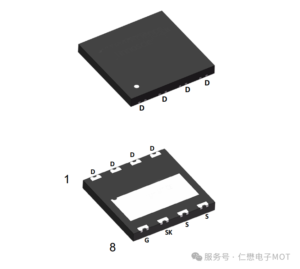

MOT Mot3080D MOS pipe
Power tool 3-bit BMS application advantage resolution
Application of core parameters in electro-tool three-decalogue BMS
A typical BMS operation of electric tool 3-cell (3S lithium) BMS: working voltage range 8. 4V (exemption threshold) ~12. 6V (excess threshold), continuous charge current 5-20A (refer to 3 sets of BMS empirical parameters), transient current 40-60A, BMS internal space compaction (with battery pack integration, severe heat dispersion conditions, environmental temperature 60-100°C), core condition of charge cycle, pass/short circuit protection, MOT3080D perfect for charge main switch (linking to battery pro/negative, control out).
Pressure parameters (V = 30V, V = 20V): Fit 3S battery voltage to protect reliability
An electric tool three-sect battery (3S) is associated with a full voltage of 12. 6 V, which can be recharged with an instant peak voltage (≤8V, generated by volatilisation of charge adaptors, electrical senses, etc. ) and the actual maximum working voltage of 20. 6 V. According to BMS MOS selection, leak-through voltage is 1. 5 times greater than the battery ' s maximum voltage, and MOT3080D ' s V = 30V (minimal value), which is more than 46% of the actual maximum working voltage, effectively inhibits the risk of peak voltage penetration and avoids BMS protection failure due to the failure of the MOSFETs (e. g. , failure to turn off recharge circuits when charged).
At the same time, MOT3080D does not require an additional chain of steady voltage resistance or drive chips, simplify BMS-driven circuit design and reduce the complexity of the PCB layout (the BMS-protective chip DW01+, FS 312, drive range 8-12V), which is commonly used in BMS, the three-saving battery BMS. In addition, leaks from the leaking source I≤1 μA (V=30V), and leaks from the bolting source ≤±100nA may reduce the ineffectual energy consumption (static power consumption ≤10 μW) of batteries and extend the waiting time of the electrical tool batteries.
Current parameters (I = 80A, I = 320A): Loading discharge currents in response to transient shocks
The current demand for BMS BMS, a power tool, varies according to the state of work: currents of 5-10A at routine charge (e. g. charge, light use), currents of 15-20A at full use, currents of 40-60A at start-up of electrical tools, and currents of 100-150A at short circuit. MOT3080D = 320A (short-time pulse current), which can easily withstand 40-60A transient currents and 100-150A transient currents at the start of electrical tools, combined with specifications (safe workspace curves), MOT3080D, which meets BMS transient conditions at 10 ms ~ 100 m pulse width, and I = 80A, pulse current I = 320A, which is suitable for the continuous flow requirements of BMS charge discharge main switches (e. g. , when the discharge is off, the electrics reverse currents generated by electric dynamics), does not require additional serial flow of two-tier tubes, simplify BMS circuit design, reduce the cost of hardware, and avoid the spreading heat pressure of running two-channel heat.

Conveyment characteristics (R≤6m): Reduce charge/balance loss and reduce BMS dispersing heat pressure
In the BMS, the MOSFETs is in the conductivity state (during the charge cycle) for a long period of time, with the loss being dominated by the loss and loss factor P=I2R, and the smaller the loss and the lower the loss, the less the heat the unit heats. MOT3080D at V = 10V, I = 20A, the typical R value is only 4 m, with a maximum value of 6 m, much better than the same type of 30V/60A BMS dedicated MOSFETs.
Switch feature (Q = 71nC, Quick Switch time): Fitable protection signal is fast Response
One of the core functions of BMS, which is a three-dimensional battery of electrical tools, is charge protection, which requires a rapid shutdown of the MOSFETs to avoid battery damage. MOT3080D Q = 71nC (typical value), with only 16. 2 nC (22. 8 per cent) of Miller ' s charge (Q) effectively reducing the time of the Miller Platform during switching and reducing the loss of the switch (40. 8 per cent less than the Q = 120nC equivalent; perfect parameters for the switch time match BMS protection needs, high switch speeds are accurate for the BMS protection chip control signal, fully disabled for short periods of time, effectively cutting down failure circuits and avoiding battery overflow damage (e. g. short-circuit battery fire, drum packs).
Temperature and dissipation characteristics: Fit for severe dissipation to ensure long-term reliability
The integration of BMS and Battery Pack in electric tools in compact battery silos with no additional heat dispersion space and heat during battery charging results in long-term maintenance of ambient temperature within BMS at 60 ~ 100 °C. The temperature of the device is highly cumulative, and if the temperature of the MOSFETs is poor, it is highly susceptible to heat failure, resulting in BMS protection failure. The MOT3080D condensed range is -55 ~150°C, even in a high temperature cumulative scenario; at the same time, the fence threshold voltage V = 1-2V (typical value 1. 5V), the specifications Vgs follow the temperature change curve, and when the temperature changes, the threshold voltage voltage of the fence voltage ~0. 5 V, avoids the extreme-drive failure of the high temperature underground fence, guarantees the long-term reliability of the device in a severe heat-dispersion environment and reduces the number of BMS malfunctions.
Summarize
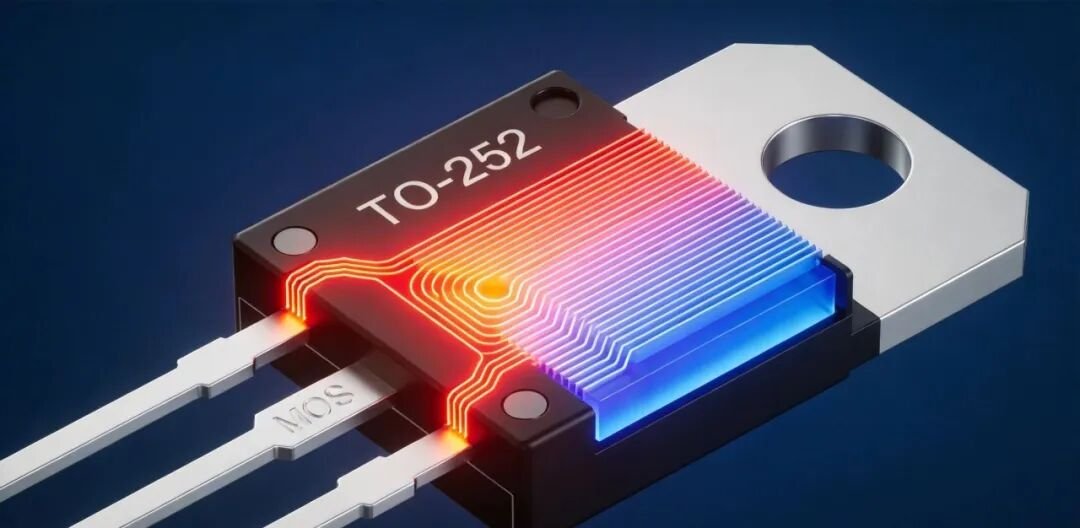
The low-pressure large current parameter (30V/80A), low-conductive general loss (4m R), excellent switch characteristics (Qg=71nC, switch time), high avalanche energy (169mJ), low-crust heat resistance (2. 04°C/W) and compact TO-252 packages, all accurately matching the core BMS requirements (charged protection, compact dissipation, transient shock resistance).