A switching power supply is usually better for efficiency, compact size, wide input range, and medium-to-high power, while a linear supply is often better for simplicity and very low broadband output noise. The right choice depends on the load, voltage drop, power, thermal budget, noise spectrum, transient behavior, safety, cost, and certification—not on topology alone.
Many products combine both: an efficient switcher creates an intermediate rail, then a low-noise LDO or discrete linear stage cleans a sensitive analog section. This avoids forcing one converter to satisfy contradictory requirements.
How the two approaches regulate
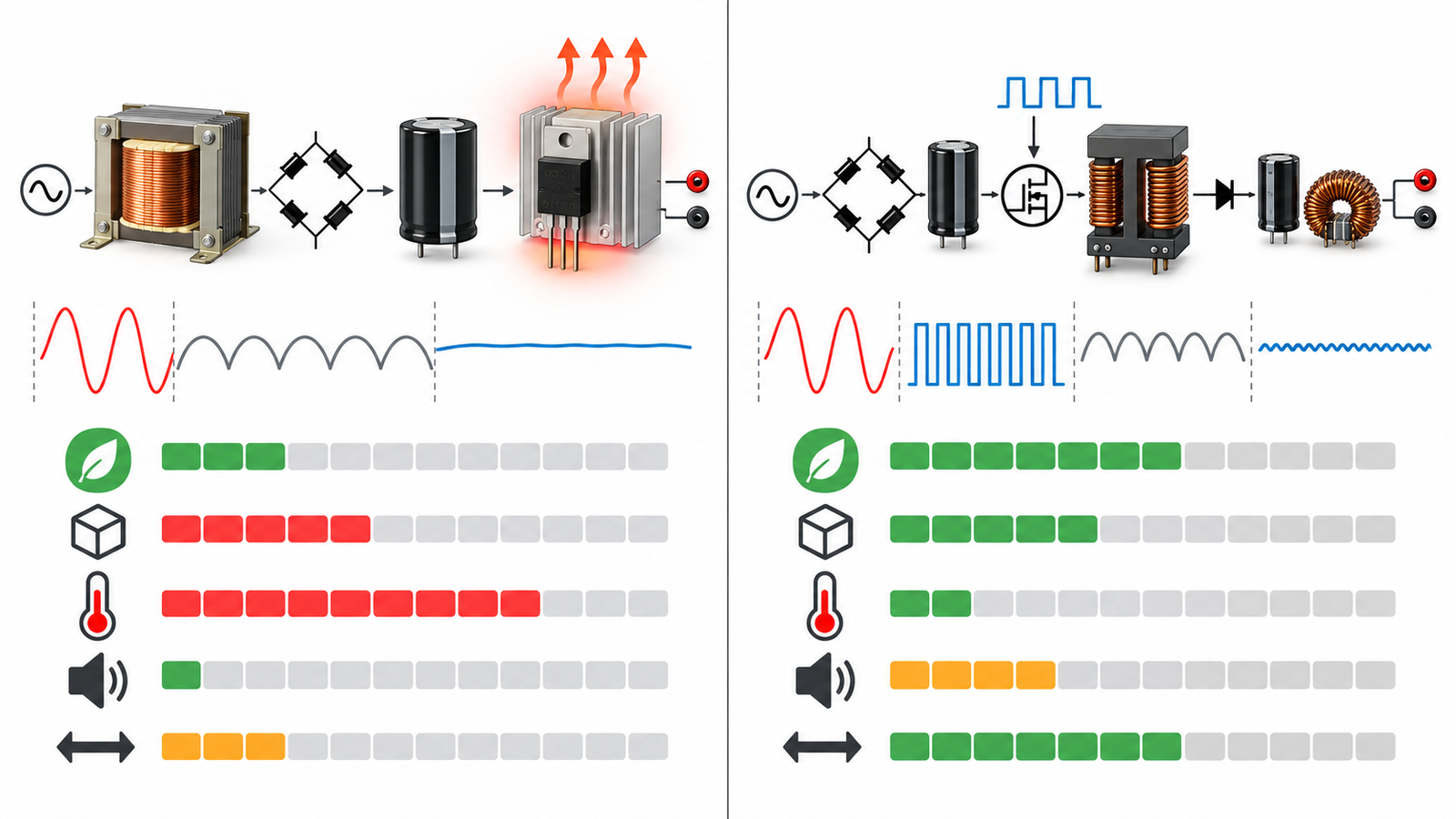
A linear regulator controls a pass device in its active region and dissipates excess voltage as heat. For a simple DC input, loss is approximately (VIN − VOUT)I. Efficiency is therefore limited roughly by VOUT/VIN before quiescent loss. A line-frequency transformer may provide isolation ahead of the regulator.
An SMPS moves energy in pulses through inductors or transformers, then filters and feeds back the output. Learn the detailed energy path in how a switching power supply works.
Efficiency and heat
When a 12 V source feeds a 5 V, 1 A linear regulator, the pass element dissipates about 7 W while the load receives 5 W. A well-designed buck converter can waste much less, reducing heatsink, enclosure, and battery requirements. The advantage grows with input-output voltage difference and load current.
At microamp loads or tiny voltage drops, switcher control loss may erase that advantage. Some converters also have pulse-skipping modes with load-dependent noise. Compare efficiency over the real load profile, including standby and startup, rather than one peak value.
Noise, ripple, and EMI
A linear regulator does not intentionally generate a switching node, so it can provide low output noise and fewer radiated-emission problems. It still passes or rejects input ripple according to frequency, layout, reference noise, output capacitor, and power-supply rejection. Rectifier charging pulses and transformer magnetic fields can remain.
An SMPS produces ripple at its switching frequency, harmonics, control sidebands, and high-frequency ringing. Good topology, layout, shielding, filtering, spread spectrum, and snubbing can make it compatible with demanding systems. Evaluate noise in the bandwidth that matters to the load; a single RMS number can hide narrow spurs.
Size, isolation, and conversion range
High-frequency magnetics are often far smaller than line-frequency transformers, giving switchers a power-density advantage. Switching topologies can step down, step up, invert, or isolate over wide ranges. Linear regulators primarily step down and need voltage headroom.
Isolation is not guaranteed by either label. An isolated SMPS uses a transformer and appropriate feedback barrier; a nonisolated buck does not. A linear bench supply may use an isolated transformer, while an LDO on a board shares ground. Check the complete architecture described in what a switching power supply is.
Transient response and load behavior
Linear regulators can react quickly, but stability depends on output capacitance, ESR, loop design, and layout. Switchers store energy in magnetics and may have lower control bandwidth, yet modern multiphase and hysteretic converters can deliver excellent transients. Load steps, minimum load, current limit, startup into capacitance, and sequencing matter more than the category name.
Audio, RF, data converters, sensors, motors, processors, LEDs, and battery chargers impose different spectra and pulse profiles. Test with the real wiring and load modes.
Cost, reliability, and hybrid design
A low-power linear rail may need few parts and be economical. At higher dissipation, its transformer, heatsink, enclosure, and energy cost can dominate. An SMPS needs a controller, magnetics, switches, EMI parts, and more validation, but integration has reduced complexity.
A common hybrid uses an SMPS followed by an LC filter, capacitance multiplier, or LDO. Leave enough headroom for dropout and transients without wasting the efficiency gained upstream. The article on MOSFET roles in power supplies explains the active switches behind many efficient stages.
Engineering checklist
Create a comparison table using input range, each output, continuous and peak current, allowable ripple by frequency, load-step limits, ambient, airflow, volume, mass, isolation, standby power, cost, lifetime, and certification. Calculate total system heat, not only regulator efficiency. Include transformer and rectifier loss for linear supplies and magnetics, switch, diode, driver, and filter loss for SMPS designs.
Evaluate the source as well as the load. Battery runtime, generator waveform, automotive transients, cable resistance, and grid quality can change the best architecture. Also compare fault behavior: a current-limited switcher, a thermally protected linear regulator, and a large transformer supply may deliver very different energy into a short.
Prototype the two leading architectures and measure noise with correct probing, transient response at the load, emissions, thermal rise, acoustic noise, and efficiency across operating modes. Consider sourcing and serviceability. For mains input, certified modules can reduce risk and compliance effort. The “better” supply is the one that meets all limits with adequate margin and predictable production behavior.
Frequently asked questions
Are linear power supplies always quieter?
They usually avoid switching ripple, but transformer fields, rectifier pulses, reference noise, grounding, and poor layout can still create noise.
Are switching supplies always more efficient?
Usually at larger voltage ratios and power, but very light loads, small drops, and control losses can change the comparison.
Can I use an LDO after an SMPS?
Yes. Ensure sufficient dropout headroom and verify the LDO’s rejection at the switcher’s ripple and ringing frequencies.
Which is better for audio?
It depends on rail power, noise spectrum, grounding, regulation, and thermal limits. Well-designed linear, switching, and hybrid supplies can all work.