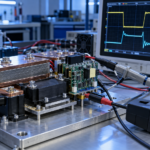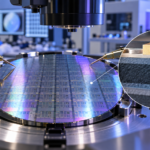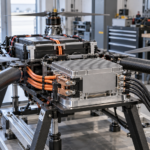
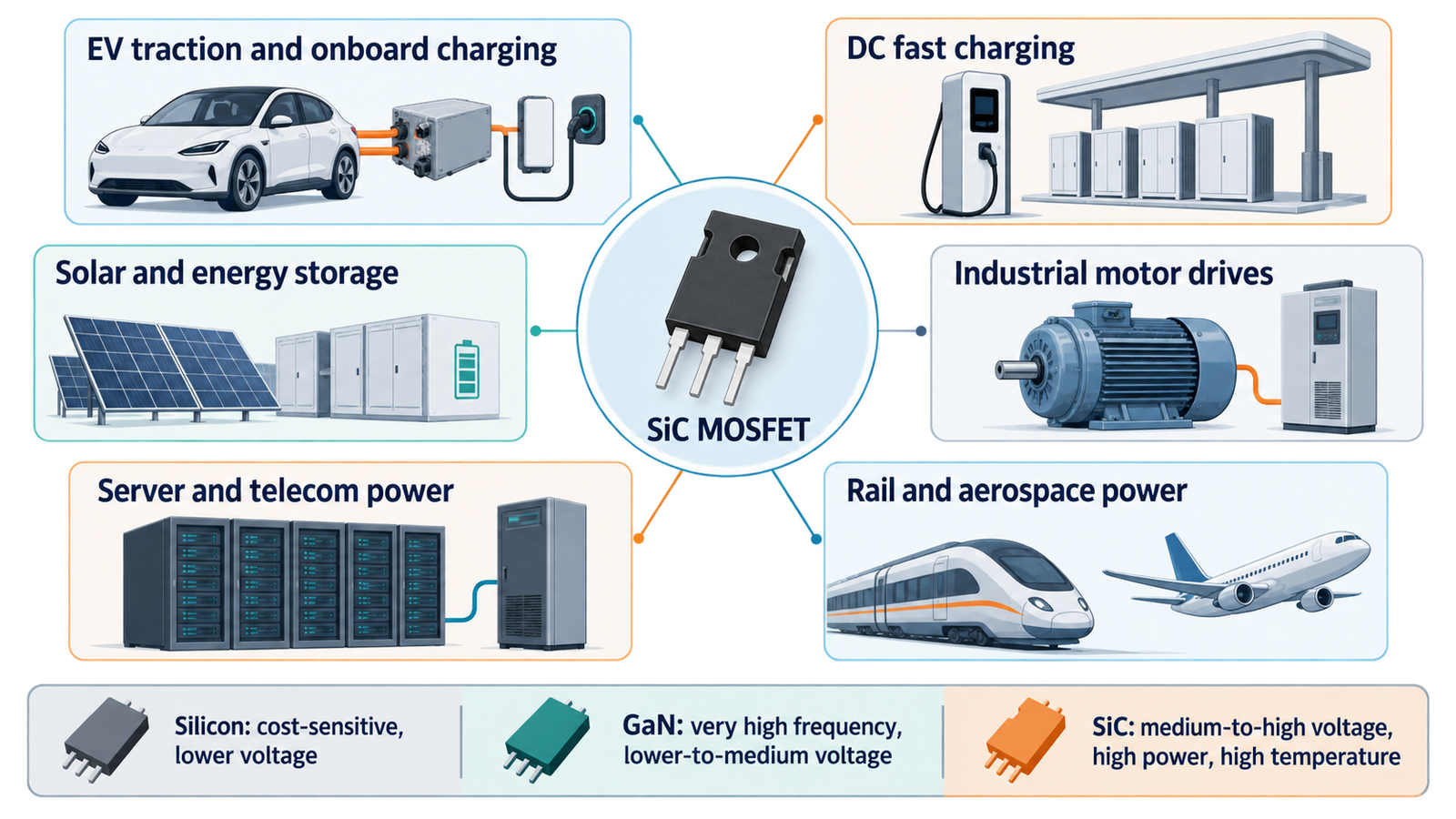
SiC MOSFETs are used mainly in medium- and high-voltage power converters that need high efficiency, high switching frequency, compact cooling, or reliable operation at elevated temperature. Common applications include electric-vehicle traction inverters and onboard chargers, DC fast chargers, solar and energy-storage inverters, industrial motor drives, server and telecom power supplies, uninterruptible power systems, rail traction, and aerospace power conversion.
Silicon carbide is a wide-bandgap semiconductor. Compared with a similarly rated silicon MOSFET or IGBT, a well-chosen SiC MOSFET can switch faster with lower switching energy and can block high voltage with a relatively compact die. Those device advantages can reduce heat, shrink magnetic components, raise power density, or improve energy conversion. They do not remove the need for careful gate drive, layout, protection, and thermal design.
Electric-vehicle traction inverters
The traction inverter converts the battery’s DC energy into controlled AC for the motor and returns energy during regenerative braking. SiC MOSFET modules are widely used in high-performance 400 V and especially 800 V vehicle architectures because lower conduction and switching loss can reduce cooling demand and improve efficiency over the drive cycle.
Faster switching may also reduce the size of some passive components, but motor-insulation stress, bearing current, cable reflections, acoustic noise, and EMI limit how fast the inverter should switch. Automotive SiC modules need robust short-circuit protection, low-inductance busbars, reliable gate isolation, liquid cooling, and lifetime validation under vibration and thermal cycling.
Onboard chargers and vehicle DC-DC converters
An onboard charger converts grid power into battery charging current. Many modern designs also support bidirectional power flow for vehicle-to-load or vehicle-to-grid operation. SiC MOSFETs are used in the power-factor-correction and isolated DC-DC stages, where they can improve efficiency and reduce magnetics and cooling volume.
High-voltage DC-DC converters use SiC to transfer energy between the traction battery and lower-voltage buses or between different battery domains. The design still needs the correct isolation level, soft-switching range, common-mode control, and fault response. The site’s guide to driving a SiC MOSFET covers the bias, Kelvin source, CMTI, gate resistance, and protection requirements behind these applications.
DC fast charging stations
Offboard chargers process tens or hundreds of kilowatts through modular AC-DC and isolated DC-DC stages. SiC’s combination of high blocking voltage and low switching loss supports efficient 800 V-class charging infrastructure and compact power modules. Higher module efficiency reduces electricity wasted as heat and can lower the size or flow requirement of the cooling system.
Charger designers must manage grid harmonics, power factor, isolation, leakage current, connector sequencing, output contactors, precharge, metering, and fault energy. Parallel power modules also need current sharing and coordinated control. A fast transistor alone does not create a fast or safe charger.
Solar inverters and energy-storage systems
Photovoltaic string inverters convert a high-voltage DC array into grid-synchronized AC. SiC MOSFETs can raise conversion efficiency, especially at partial load, and allow higher switching frequency or fewer conversion levels in some architectures. Lower loss improves energy yield and reduces cooling burden in outdoor enclosures.
Battery energy-storage systems use bidirectional converters between the battery, DC bus, and grid. SiC is attractive where the converter cycles large amounts of energy every day and must remain efficient in charge and discharge. Designers still balance semiconductor cost against lifetime energy savings, filter size, acoustic limits, serviceability, and the chosen DC-link voltage.
Industrial motor drives and servo systems
Industrial drives control pumps, compressors, robots, machine tools, and high-speed motors. SiC can reduce inverter loss and permit a smaller or fanless drive in applications where enclosure size, maintenance, or ambient temperature matters. High switching frequency can also improve current control or reduce motor-filter size.
Fast voltage edges can stress motor winding insulation and create common-mode bearing currents, especially with long cables. Output filters, controlled gate resistance, shield termination, grounding, and dv/dt management are therefore system requirements. The optimum design often switches more slowly than the device’s maximum capability.
Server, data-center, and telecom power
Data centers process power through several stages, including facility distribution, UPS systems, power-factor correction, high-voltage DC buses, rack power shelves, and point-of-load conversion. SiC MOSFETs are used mainly in the higher-voltage front-end stages, where small improvements in conversion efficiency can reduce heat and cooling overhead across continuously operated equipment.
Telecom rectifiers and high-density server supplies value power density, redundancy, hot-swap behavior, hold-up time, and high efficiency over a broad load range. SiC may be paired with silicon or GaN devices in the same system because each voltage and frequency stage has different priorities.
Uninterruptible power supplies and solid-state protection
UPS equipment uses rectifier, battery-converter, and inverter stages to maintain power during disturbances. SiC devices can reduce losses during normal operation and support compact high-voltage conversion. In static transfer switches or solid-state circuit breakers, high-voltage SiC devices can interrupt or route current without mechanical contacts, although fault energy, surge withstand, isolation, and protection timing remain demanding.
Rail traction and auxiliary power
Rail vehicles use high-power inverters for traction motors and converters for lighting, HVAC, controls, and battery systems. High-voltage SiC modules can reduce converter mass and cooling demand, which is valuable in vehicles where every kilogram and service interval matters. Railway applications also require long lifetime, vibration resistance, fire-safety compliance, and tolerance to a harsh electrical environment.
Aerospace, drones, and high-altitude systems
Aircraft electrification, actuators, generators, propulsion research, and high-voltage DC distribution benefit from power density and reduced cooling mass. SiC can operate at higher junction temperatures than many silicon alternatives, but the complete package, gate driver, capacitor, magnetic component, and insulation system may have lower temperature limits.
Radiation and altitude require separate qualification. The article on SiC MOSFET radiation susceptibility explains why terrestrial reliability data cannot automatically be applied to space. For smaller airborne systems, using SiC MOSFETs in drones discusses when their voltage and power advantages justify the extra design complexity.
High-temperature and harsh-environment conversion
SiC’s material properties enable high-temperature operation, but a commercial system is limited by packaging, solder or sinter layers, bond wires, substrate, encapsulant, connectors, capacitors, magnetics, sensors, and control electronics. Oil-and-gas tools, geothermal equipment, aviation, and industrial equipment may use SiC to move the power stage closer to a hot process, but only after the whole assembly is rated and life-tested.
Why SiC improves these applications
- Lower switching loss: supports higher frequency or higher efficiency at the same frequency.
- High blocking voltage: suits hundreds to thousands of volts with useful on-resistance.
- Low reverse-recovery charge: reduces commutation loss compared with many silicon body-diode paths.
- High-temperature capability: provides more junction-temperature margin when the package and system support it.
- Power density: lower loss and higher frequency can shrink cooling and magnetics.
These advantages are conditional. Very fast edges increase overshoot, ringing, insulation stress, and common-mode current. The related article on negative gate bias for SiC MOSFETs shows how even the off-state drive becomes a system-level decision.
When silicon or GaN may be a better choice
At low voltage, a silicon MOSFET may offer excellent resistance, ruggedness, controller availability, and cost. Silicon IGBTs remain competitive in cost-sensitive high-power converters with moderate switching frequency. GaN transistors are especially attractive for very high-frequency conversion at lower to medium voltage, including compact adapters and some data-center stages.
SiC is most compelling when voltage, power, efficiency, cooling, or temperature makes silicon losses expensive and when the application can use a suitable gate driver and low-inductance layout. Compare total converter cost and lifetime energy, not just the price of the transistor.
Design requirements unique to fast SiC switching
Use the manufacturer’s recommended gate-voltage window and an isolated driver with adequate common-mode transient immunity. Place the driver close to the device, use a Kelvin-source return when available, minimize the commutation loop, and control turn-on and turn-off separately. Add short-circuit protection that responds within the device’s verified withstand time.
Measure gate voltage directly from gate to Kelvin source with a suitable probe. Validate drain overshoot, current, switching energy, false turn-on, EMI, and junction temperature. Tune speed to the system rather than selecting the smallest possible gate resistance.
How to decide whether to use SiC
- Define bus voltage, power, switching frequency, isolation, ambient temperature, cooling, and lifetime.
- Compare silicon, IGBT, GaN, and SiC device stress and loss across the full operating map.
- Include gate driver, magnetics, filters, heatsink, assembly, and compliance cost.
- Check package creepage, module inductance, short-circuit behavior, avalanche capability, and reliability data.
- Prototype the complete power loop and perform double-pulse, thermal, EMI, and fault testing.
- Choose SiC when the system-level benefit justifies its component and engineering cost.
Frequently asked questions
Are SiC MOSFETs only for electric cars?
No. EVs are a major use, but SiC also serves solar, storage, chargers, industrial drives, UPS, data centers, telecom, rail, aerospace, and high-temperature power systems.
What voltages are SiC MOSFETs used at?
Commercial families span several voltage classes, commonly including 650 V, 750 V, 900 V, 1200 V, 1700 V, and higher. Choose from the actual bus, surge, topology, and required design margin.
Do SiC MOSFETs always run cooler?
Not automatically. They can dissipate less power in a suitable converter, but temperature also depends on conduction current, switching speed, package, interface, heatsink, airflow, and control.
Can I replace a silicon MOSFET with SiC directly?
Usually not as a drop-in change. Gate voltage, threshold, switching speed, package pinout, driver current, layout, EMI, protection, and thermal behavior must all be reviewed.