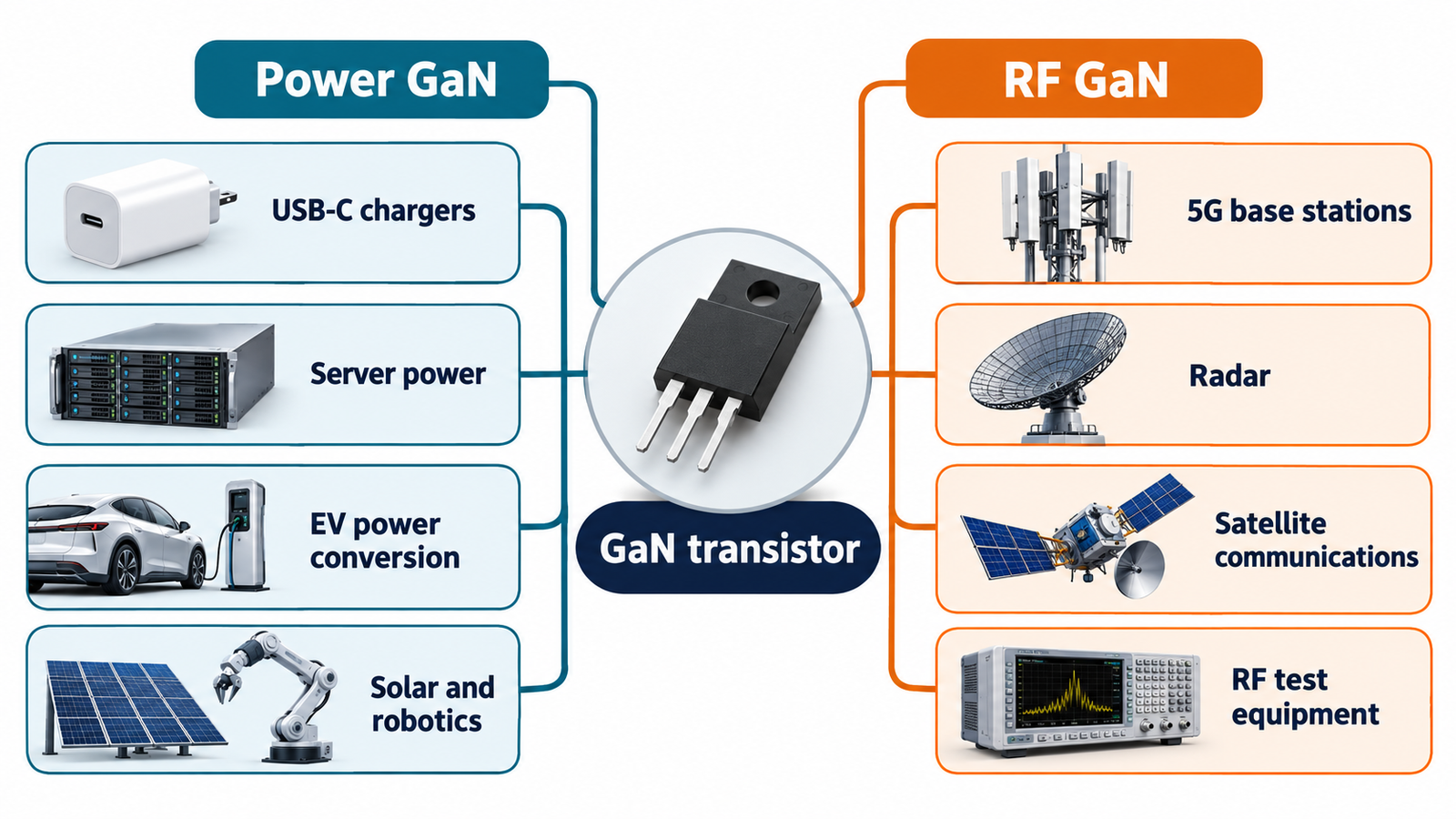
GaN transistors are used in high-density power converters and high-power radio-frequency systems. Common power applications include USB-C adapters, server and telecom power supplies, data-center converters, EV onboard chargers, solar inverters, lidar pulse drivers, wireless power, and selected motor drives. RF GaN devices appear in cellular base stations, radar, satellite links, and aerospace transmitters.
Gallium nitride is valuable because its material properties enable fast devices with low charge and strong electric-field capability. The benefit is not automatic: the surrounding package, gate driver, PCB, magnetics, cooling, control, and EMI filter must exploit those characteristics.
Compact consumer power adapters
Fast switching lets designers reduce the size of transformers, inductors, and some filters. That is why GaN is visible in compact high-wattage USB-C chargers and travel adapters. Totem-pole power-factor correction and high-frequency resonant conversion are common building blocks. Lower charge and capacitance can reduce switching loss, but light-load behavior, standby power, transformer construction, safety spacing, and thermal density still decide the product’s performance.
Readers new to the architecture can start with what a switching power supply is. GaN changes the attainable frequency and loss balance; it does not remove the need for isolation, feedback, protection, or compliance.
Server, telecom, and data-center power
Rack equipment values efficiency and power density because conversion loss becomes facility heat. GaN devices can serve front-end PFC, intermediate bus, and point-of-load stages, particularly where high switching frequency shrinks passives and improves transient response. At high current, layout resistance and thermal spreading may dominate, so package choice and copper design are critical.
The business case is system-level: a more expensive switch can be worthwhile if it reduces magnetics, cooling, rack space, or energy use. Conversely, a conventional silicon MOSFET may remain best where switching frequency is modest and cost pressure is severe.
Automotive charging and energy conversion
GaN is being applied to onboard chargers, DC-DC converters, and auxiliary supplies, especially around the 400 V battery class. Designers pursue smaller magnetics and high efficiency across a wide load range. Qualification, short-circuit behavior, gate-driver supply, isolation, common-mode current, cooling, and automotive transients are central constraints.
Higher-voltage traction inverters often favor SiC today because voltage class and ruggedness differ, although GaN continues to advance. The site comparison of where SiC MOSFETs are used helps separate overlapping wide-bandgap applications.
Lidar, robotics, and fast pulsed loads
A lidar transmitter needs a short, high-current pulse through a laser diode with tightly controlled timing. GaN’s low charge and low inductance can create fast edges and narrow optical pulses, improving distance resolution when the entire current loop is compact. The gate driver, decoupling capacitor, laser, switch, and return path must be physically close; a long trace can erase the device advantage.
See how GaN power transistors drive high-performance lidar for the pulse-loop details. Similar techniques apply to time-of-flight sensing, pulsed illumination, and some scientific instruments.
RF amplifiers for communications and radar
RF GaN, often GaN-on-SiC, is optimized differently from low-voltage enhancement-mode power GaN. It can deliver high RF power density, gain, efficiency, and operation at microwave frequencies. Cellular base stations, radar transmitters, electronic warfare, satellite payloads, and test equipment use GaN power amplifiers where thermal management and linearity are engineered carefully.
RF designers consider load lines, matching networks, stability, bias, harmonic termination, package parasitics, and linearization. A power-conversion GaN FET should not be substituted into an RF amplifier merely because both are called GaN transistors.
Wireless power, audio, and motor control
High-frequency wireless-power transmitters and Class D or Class E stages can benefit from low switching charge and capacitance. Specialized audio amplifiers may use GaN to reduce switching loss and extend bandwidth, although output filtering and EMI remain necessary. Small high-speed motors and robotics converters can also benefit where frequency and compactness matter.
These are conditional uses rather than blanket recommendations. Motor drives face repetitive current, dead-time, reverse conduction, cable EMI, and fault requirements. The optimum device depends on bus voltage, current, switching frequency, cooling, cost, and control strategy.
When GaN is not the best choice
Do not select GaN solely for a higher data-sheet frequency. Silicon MOSFETs have mature drive ecosystems, broad sourcing, and excellent cost at many voltage levels. SiC may offer a better combination of voltage, temperature, and ruggedness above common 650 V classes. Slow converters gain little from GaN if conduction, magnetics, or rectifier loss dominates.
If GaN is justified, use the vendor’s recommended gate voltage, driver, footprint, and layout. Minimize common-source and power-loop inductance, control overshoot, verify dead time, and measure with low-inductance probes. The principles in balancing switching efficiency and EMI apply, although GaN’s allowable gate range and switching speed demand extra discipline.
Frequently asked questions
Is GaN used only in chargers?
No. Chargers are highly visible, but GaN also serves data centers, telecom, lidar, RF amplifiers, radar, satellite systems, automotive converters, wireless power, and other high-frequency equipment.
Is every GaN transistor an RF device?
No. RF GaN and enhancement-mode power GaN are distinct product families optimized for different frequencies, voltages, packages, and operating modes.
Can GaN replace any MOSFET?
No. Drive voltage, reverse behavior, package, voltage margin, protection, layout, thermal path, and fault response must be redesigned and validated.
Why does layout matter so much with GaN?
Very fast current and voltage edges interact with tiny parasitic inductances and capacitances, causing overshoot, ringing, EMI, loss, and false switching.