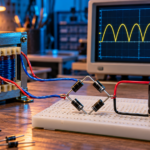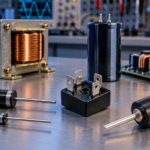
A Zener diode can act like an ordinary silicon diode when forward-biased, so it can perform basic rectification in principle. In practice, use a diode designed and rated for rectification. Zener diodes are optimized and specified mainly for controlled reverse breakdown, voltage reference, regulation, and clamping. A rectifier must safely handle repetitive forward current, reverse voltage, surge current, heating, and—at higher frequency—reverse recovery.
The fact that a component passes current in one direction is not enough to make it a good rectifier for a particular supply.

What happens in forward bias
With its anode positive relative to its cathode, a Zener diode has a forward characteristic similar to an ordinary silicon PN diode. It begins carrying significant current at a forward voltage on the order of a typical silicon junction, depending on current and temperature. If placed in series with an AC source and load, it can pass one polarity and block the other until its reverse behavior becomes relevant.
The basic mechanism is reviewed in what a rectifier diode is. Similar junction physics does not make device ratings interchangeable.
Why a rectifier diode is the safer choice
Rectifier data sheets emphasize average forward current, repetitive peak reverse voltage, surge current, forward drop, thermal resistance, leakage, and sometimes reverse recovery. Packages and die area are selected for current and heat. Zener data sheets emphasize breakdown voltage at a test current, dynamic impedance, tolerance, temperature coefficient, and power dissipation in reverse breakdown.
A small Zener may have insufficient forward-current or surge capability for charging a reservoir capacitor. It may also cost more, leak more at the relevant reverse voltage, or lack the recovery behavior required by a switching converter.
Zener voltage is not a rectifier rating
The marked Zener voltage is the approximate reverse-breakdown voltage at defined current and temperature. It is not a general statement that the diode can block that voltage indefinitely without current. Once reverse voltage reaches the breakdown region, current can rise rapidly and must be limited. In a rectifier position, this may clip the waveform, overheat the diode, or short energy through the source.
Always distinguish VZ, maximum power, test current, leakage, forward current, and any repetitive reverse-voltage specification. Do not infer missing ratings.
Frequency and reverse recovery matter
At 50 or 60 Hz, a conventional silicon rectifier may be adequate. In a high-frequency SMPS, stored charge and reverse recovery can create loss, current spikes, ringing, and EMI. Fast-recovery, ultrafast, Schottky, SiC Schottky, or synchronous rectification may be appropriate depending on voltage and current.
The article on what a Schottky diode is explains its low forward drop and reverse-leakage tradeoff. A general-purpose Zener should not be assumed fast enough merely because it is physically small.
When a Zener may serve both purposes
In a low-current signal or protection circuit, a Zener can forward-clamp one polarity and avalanche-clamp the other. Bidirectional transient suppressors use related behavior. This is clamping, not efficient power rectification. Current-limiting impedance and pulse-energy ratings must be explicit, and the resulting clamp voltages must be safe for the protected circuit.
Such a design may be intentional in an input-protection network, waveform limiter, or small reference circuit. It should not be generalized to bridge rectifiers, battery chargers, or mains power.
How to choose the correct rectifier
Determine maximum repetitive reverse voltage including transients, average and RMS forward current, peak surge when capacitors charge, allowable forward loss, junction temperature, cooling, frequency, and recovery requirements. Add design margin and use the manufacturer’s curves at the real temperature. Confirm package creepage and assembly constraints.
For a bridge, remember that two diodes conduct in series in each half-cycle; the bridge-rectifier diode-count guide explains the paths and voltage drop.
Test the circuit, not just the diode
Measure forward current waveform, reverse voltage, temperature, output ripple, startup surge, and behavior at high line and maximum load. Capacitor-input rectifiers draw narrow current peaks much higher than average output current. Source impedance, transformer regulation, and load transients can change stress.
If replacing an existing part, match or improve every relevant rating and verify polarity and package. Do not use a Zener because its printed voltage appears close to the circuit voltage. Use a rectifier whose data sheet explicitly supports the job.
A substitution decision checklist
If a Zener is proposed because it is already available, compare it line by line with the intended rectifier. Confirm maximum average and peak forward current, nonrepetitive surge, repetitive reverse voltage, forward drop, leakage, junction temperature, power derating, recovery data, package polarity, and qualification. Missing data is not evidence that a parameter is adequate. The source, reservoir capacitor, wiring, and fuse determine surge energy and must be included.
Then ask what happens on the blocked half-cycle. If the applied reverse voltage reaches the Zener region, calculate current through every limiting impedance and the instantaneous and average diode power. Check whether clamping changes output polarity, charges an unintended node, or overloads the transformer. For a small intentional limiter, that behavior may be correct. For a power rectifier, it is usually a failure mode. A purpose-rated rectifier is generally cheaper, more predictable, and easier to qualify.
Frequently asked questions
Will a Zener conduct like a normal diode forward-biased?
Yes, broadly like a silicon junction diode. That does not guarantee sufficient current, surge, recovery, or thermal performance for rectification.
Can a 12 V Zener block 12 V in a rectifier?
At about its breakdown region it is intended to conduct reverse current, not behave as an open switch. Do not equate Zener voltage with a rectifier blocking rating.
Can a Zener replace a 1N4007?
Not as a general substitution. Compare forward current, reverse voltage, surge, leakage, power, recovery, and package; normally use the intended rectifier.
Is a TVS diode a rectifier?
A TVS is optimized to absorb transient energy by clamping. It may conduct forward, but it is not normally selected for continuous rectification.