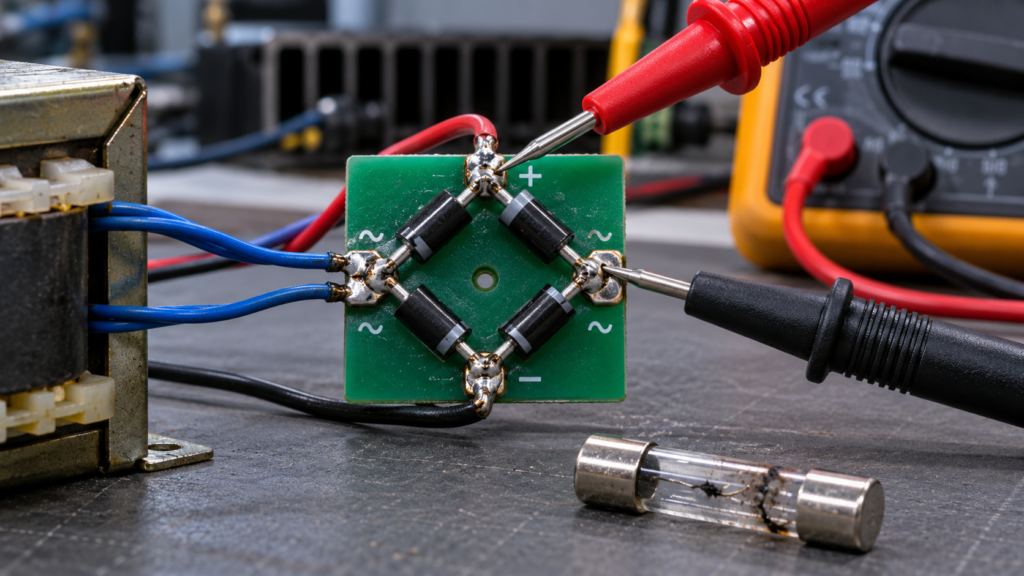
What Happens When a Diode Shorts in a Bridge Rectifier?
A shorted bridge-rectifier diode creates an abnormal low-impedance current path that can blow a fuse, overheat the transformer, damage other diodes, and stress downstream capacitors.
Browse: Power Diode Power Mosfet Power Transistors
Technical knowledge hub
Recovery, conduction, surge and thermal behavior in rectifier applications.
A shorted bridge-rectifier diode creates an abnormal low-impedance current path that can blow a fuse, overheat the transformer, damage other diodes, and stress downstream capacitors.
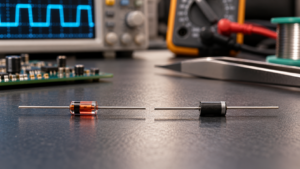
The 1N4148 is a fast small-signal silicon p-n switching diode, not a Schottky diode; its ratings and behavior should not be confused with parts such…
The 1N4007 is a general-purpose silicon p-n rectifier rated for high reverse voltage, not a Schottky diode and not a fast switching rectifier.
Identify a Schottky diode by combining its full marking and data sheet with package pinout, circuit role, diode-mode behavior, capacitance, leakage, and rated voltage.
Connect a Schottky diode only after identifying its anode and cathode, defining the required current direction, and checking reverse voltage, surge current, leakage, and thermal…
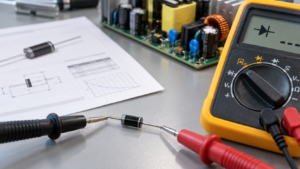
Check a Schottky diode with power removed, capacitors discharged, and a multimeter in diode mode, then verify leakage and loaded behavior when a simple test…
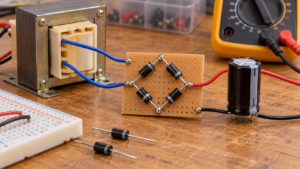
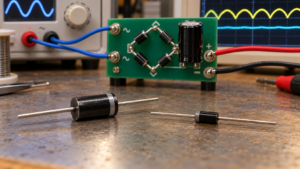
Build a full-wave bridge rectifier with four appropriately rated diodes arranged so two conduct on each AC half-cycle and produce fixed positive and negative DC…
A Zener diode can conduct forward like a silicon diode, but it is normally the wrong rectifier because rectifier current, surge, recovery, and thermal ratings…