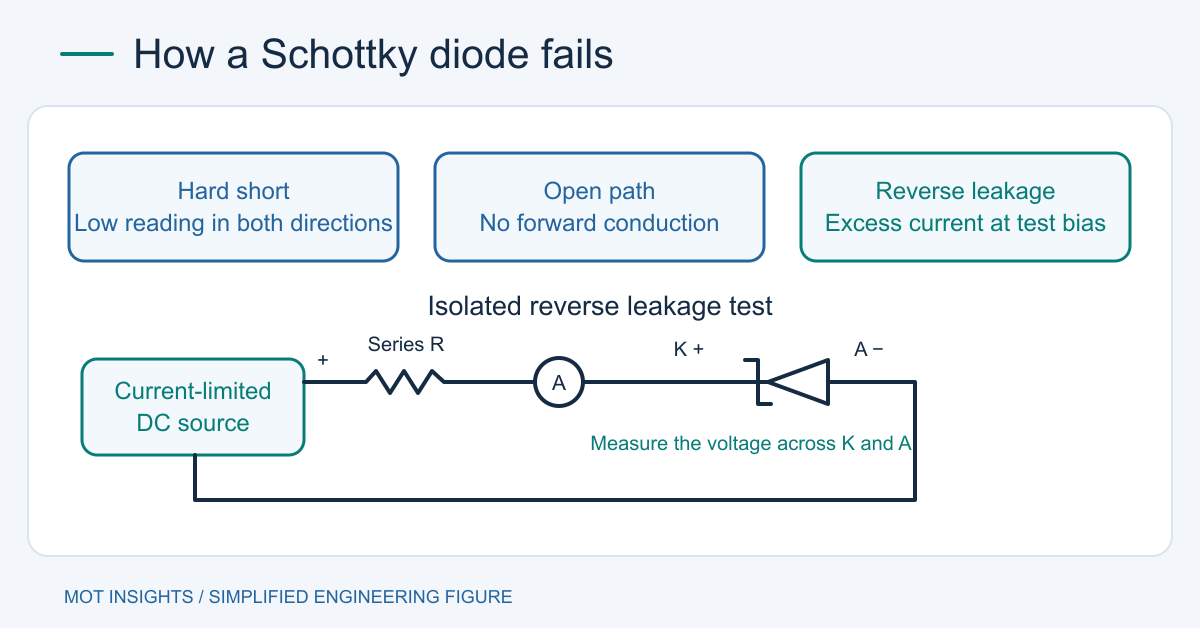
A Schottky diode can fail as a short circuit, an open circuit or a device with excessive reverse leakage. A short may drag down a power rail. An open can interrupt rectification or power delivery. A leaky diode may give a plausible forward reading on a meter and still fail to block voltage when hot. The failure signature identifies what to check next.
Match the symptom to the next test
| Fault signature | Common electrical observation | Useful next check |
|---|---|---|
| Hard short | Very low reading with either meter polarity after isolating the part | Check reverse overshoot, overload and voltage margin |
| Open path | No measurable forward conduction at the test current after confirming the pins | Inspect solder joints, terminations and overload history |
| Excessive reverse leakage | Forward drop may look normal. Reverse current rises beyond the accepted limit at the test condition | Compare with the datasheet or a known-good part at the same voltage and temperature |
| Intermittent conduction | Output changes after warm-up or with board movement | Compare device and joint behavior through controlled temperature changes |
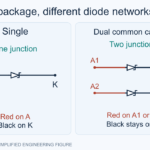
Switch off and disconnect the equipment, discharge stored energy using the approved procedure and verify de-energization before resistance or diode-mode tests. Parallel windings, capacitors, semiconductors and resistors distort in-circuit readings. If readings are ambiguous, lift one terminal or remove the part and identify the package pinout. Dual Schottky packages can share an anode or cathode, so check each junction independently. How to check a Schottky diode
Find the stress that produced the fault
Reverse voltage spikes can exceed the normal reverse voltage rating even if the DC level is within range. A long current loop, transformer leakage inductance and fast switching edges can create ringing at the rectifier terminals. On a low-voltage test assembly with appropriate probing and current limiting, check worst-case peak inverse voltage at startup, maximum input and load changes. Use the datasheet’s repetitive reverse rating and any specified avalanche or pulse limits. Avoid treating a non-repetitive rating as continuous margin.
Forward current and forward surge ratings apply to stated test conditions. An inrush into a large capacitor or repeated restarting into a fault can stress the device much more than the steady current suggests. Check the waveform and the time between pulses. Examine PCB copper, solder coverage, mounting interface and local heating from adjacent components. A loose or cracked joint can produce an open path even when the diode itself tests correctly after removal. Schottky diode operation and selection
How reverse leakage becomes a heating problem
In reverse bias, approximate dissipation at a steady point is P_R = V_R × I_R. For an illustrative 30 V reverse bias, 1 mA produces 30 mW, while 20 mA produces 0.6 W. Neither current establishes a generic pass or fail limit. Find the relevant datasheet condition for the actual part. Because leakage generally rises with junction temperature in a silicon Schottky, reverse loss can feed back into heating. In a switched rectifier, take the time average of forward and reverse loss, and consider what changes when a hot device suddenly has to block voltage. Preventing thermal runaway in Schottky rectifiers
To characterize reverse leakage on an isolated diode, follow a documented low-voltage test setup within both device and instrument ratings. Use a current-limited source with a suitable series resistor or a source-measure instrument. Put the positive terminal on the cathode, measure the actual voltage across the diode and log the current after settling. If the device heats during a measurement, temperature becomes part of the result. Match the datasheet conditions or compare with a known-good part using the same setup.
Replace and verify under the actual load
Match the junction count, pinout, repetitive reverse voltage, forward current, surge conditions, hot leakage, forward drop and thermal path. Substituting solely on package size or the lowest room-temperature forward voltage can miss a reverse-loss trade-off. Confirm startup, voltage peaks and stabilized temperature at representative input and load. If the part isolates power sources, test the reverse-blocking case as well as normal forward operation. Schottky diodes for backfeed prevention
Frequently asked questions
Does a low forward drop mean the diode is shorted?
Schottky parts often have a low diode-mode drop. A low reading in both polarities on an isolated junction is stronger evidence of a short. Compare the forward value at the stated test current and check reverse behavior independently.
Can a failed Schottky work when cold?
Yes. Temperature-sensitive leakage or a marginal joint may become noticeable only after warm-up. Compare cold and hot measurements and confirm the operating voltage, load and temperature at which the symptom appears.
If a replacement keeps failing, share the measured reverse peak, forward current waveform and operating temperature with the MOT applications team.