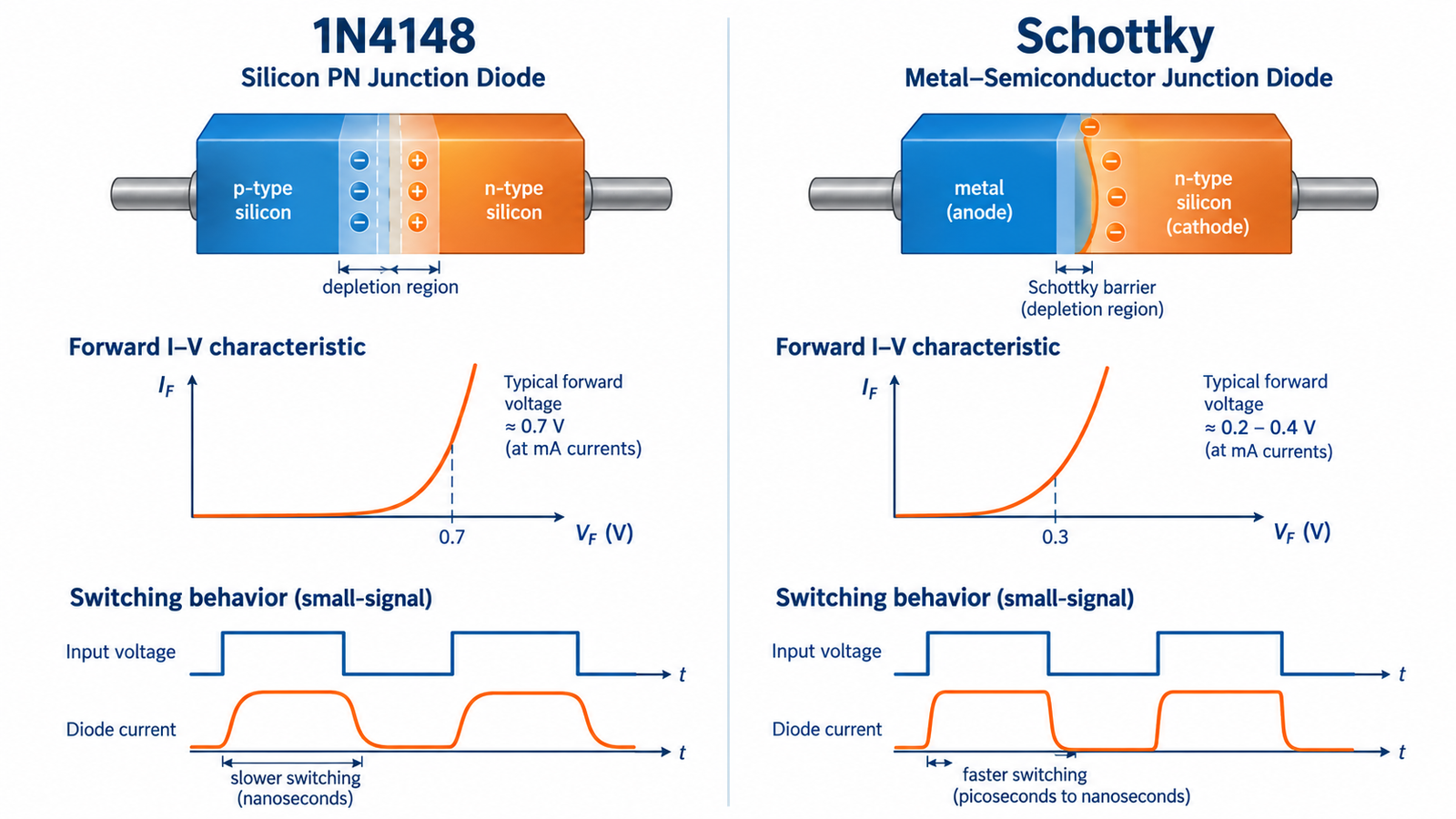
No, the 1N4148 is not a Schottky diode. It is a fast small-signal silicon p-n switching diode. Manufacturers describe it as a silicon epitaxial planar diode intended for high-speed switching and general small-signal use.
The confusion comes from speed: both a 1N4148 and many Schottky diodes switch faster than ordinary power rectifiers. They achieve that behavior through different structures and have different forward-voltage, leakage, capacitance, current, and reverse-voltage tradeoffs.
What the 1N4148 is designed to do
The device is commonly used for logic steering, signal clipping, small clamps, pulse shaping, and low-current switching. It offers fast reverse recovery and modest junction capacitance in small glass or surface-mount equivalents. Its current and surge capability are far below many power rectifiers, so it is not a universal substitute.
Always check the exact maker and package because limits and thermal conditions can vary.
How a Schottky diode differs
A Schottky diode uses a metal-semiconductor barrier rather than a conventional p-n junction. It often has lower forward voltage and negligible minority-carrier reverse recovery, but can have higher reverse leakage and different voltage limits. Modern silicon p-n switching diodes can also be extremely fast, so “fast” does not mean “Schottky.”
See what a Schottky diode is for the structural distinction.
Compare forward voltage correctly
A multimeter may show roughly 0.6 to 0.8 V for a 1N4148 at its test current, while a Schottky may show a lower value. But forward voltage depends on current, temperature, die area, and chemistry, and the ranges overlap. A low reading supports an identification; it does not prove the technology.
Use the data sheet and full part marking as the authoritative source.
Why substitution can fail
Replacing a 1N4148 with a Schottky changes clamp level, leakage, capacitance, and reverse-voltage margin. In a high-impedance sensor node, hot Schottky leakage may create offset. In a timing or RF circuit, capacitance matters. In a protection network, the lower forward voltage may be beneficial—but only if the reverse rating and pulse energy are adequate.
The selection guide on when to use a Schottky diode frames those tradeoffs.
Identify an unknown diode
Read the full body or reel marking, package, polarity band, board reference, and circuit function. Search official manufacturer cross-references and data sheets. Measure forward and reverse behavior only with power removed and stored energy discharged. Tiny SMD top codes can map to multiple parts, so package dimensions and circuit context are essential.
A band commonly indicates cathode, not diode technology.
Choose the correct replacement
Match repetitive reverse voltage, average and peak current, surge waveform, forward voltage at operating current, reverse recovery, capacitance, leakage at hot temperature, package, polarity, and thermal resistance. If the diode shapes an analog signal, validate the complete transfer function; if it clamps a transient, validate pulse energy and overshoot.
Do not replace from a generic “fast diode” label alone.
Turn the answer into a component decision
For Is the 1N4148 a Schottky Diode?, begin with a table of the real electrical conditions: normal forward current, RMS and peak current, surge waveform, repetitive reverse voltage, switching frequency, ambient and board temperature, cooling, duty cycle, and allowed voltage drop. Add the abnormal cases—capacitor inrush, output short, reversed connection, open load, and line surge. A family name or familiar part number cannot replace this requirement set.
Compare candidates using guaranteed limits at relevant temperatures. Record the exact test current behind forward voltage, the pulse shape behind a surge rating, and the conditions behind reverse-recovery or capacitance values. Check package polarity, land pattern, terminal current density, copper area, creepage, and whether the part’s metal surface is electrically live. If several junctions share a package or heatsink, include thermal coupling and fault propagation rather than treating each junction independently.
On a prototype, start at reduced available energy and verify polarity before increasing load. Capture current and voltage simultaneously when switching behavior matters. Run long enough to reach thermal equilibrium, then repeat at the hottest input and load corner. Finally, document why the chosen part is suitable and which measurements confirm it. This traceable process is more reliable than substitution by appearance, a room-temperature diode-mode reading, or a single maximum rating.
Practical validation checklist
Confirm the exact part number and polarity before applying power. Check repetitive reverse voltage, average and RMS forward current, surge current, forward drop at the real current, leakage at the hottest credible junction temperature, package thermal resistance, and any recovery or capacitance requirement. A diode that passes a room-temperature multimeter check can still be unsuitable at operating voltage, frequency, or temperature.
Commission with current limiting where practical, then measure loaded forward drop, reverse stress, case temperature, and switching waveform. Inspect fuses, capacitors, connectors, PCB discoloration, and the load when a rectifier has failed; replacing only the visibly damaged diode can leave the initiating fault untouched. See rectifier-diode fundamentals for the wider selection context.
Frequently asked questions
Is a 1N4148 a rectifier diode?
It can rectify small signals, but it is categorized as a small-signal switching diode rather than a power rectifier.
What Schottky part replaces a 1N4148?
There is no universal replacement. Choose one from the circuit’s voltage, current, leakage, capacitance, and clamp requirements.
Is 1N914 the same as 1N4148?
They are often close and sometimes cross-referenced, but confirm the exact manufacturer specifications and application.
Can I use a 1N4148 as a flyback diode?
Only for low coil current and pulse energy within its ratings; larger relays or solenoids usually need a more capable diode.