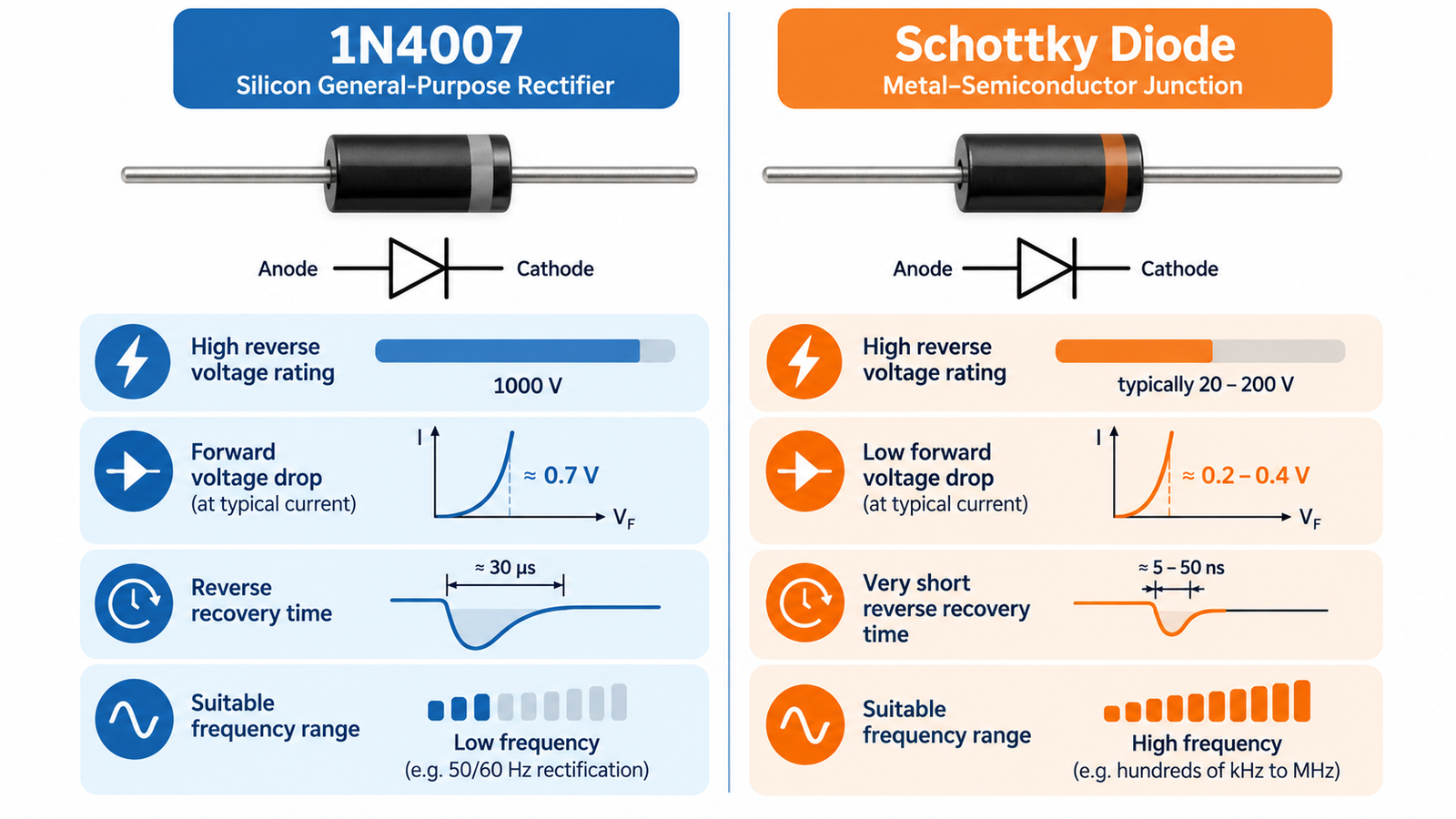
No, the 1N4007 is not a Schottky diode. It belongs to the 1N4001–1N4007 family of general-purpose silicon p-n rectifiers. The 1N4007 is the high-reverse-voltage member of that family and is widely used for line-frequency rectification, polarity protection, and low-speed flyback duties within its ratings.
A Schottky diode uses a different junction and often offers lower forward voltage and faster commutation, but usually with different leakage and voltage tradeoffs. Because several diode families share similar axial packages and cathode bands, identify technology from the complete part number and an official data sheet rather than from appearance.
What the 1N4007 is
The part is a roughly ampere-class axial rectifier, with exact current depending on mounting and thermal conditions. Its principal distinction within the family is high repetitive reverse-voltage capability. It is not specified as an ultrafast device, so high-frequency switching applications require caution.
Manufacturer data sheets, not marketplace descriptions, are the authoritative reference.
Why it is confused with Schottky parts
Both devices are two-terminal diodes with a cathode band, and both can rectify current. Package appearance does not identify junction technology. Some users also assume that any power diode is Schottky because Schottky rectifiers are common in low-voltage supplies.
The article on Schottky-diode structure explains the real distinction.
Forward voltage and leakage
At comparable current, a silicon p-n rectifier often has a higher forward voltage than a low-voltage Schottky. However, drop depends strongly on current and temperature, and high-voltage Schottky or SiC behavior differs. Schottky reverse leakage can be much higher at elevated temperature.
Do not select from a single room-temperature multimeter reading.
Reverse recovery and frequency
A 1N4007 can store charge that must be removed when voltage reverses. At 50 or 60 Hz this is often unimportant; in a tens- or hundreds-of-kilohertz converter it can cause loss, ringing, and switch stress. Use an ultrafast, Schottky, or SiC diode characterized for the actual switching waveform when required.
The correct choice depends on both reverse recovery and junction capacitance.
Can a Schottky replace a 1N4007?
Only if its repetitive reverse voltage, surge and average current, hot leakage, forward loss, package, polarity, temperature, and safety margin all fit. Many familiar Schottky parts have far lower voltage ratings than a 1N4007. In a low-voltage circuit, a Schottky may improve drop; in a high-voltage rectifier, an unsuitable substitution can break down immediately.
Use Schottky selection guidance for a requirement-based comparison.
Test and identify the device
With power removed and capacitors discharged, diode mode should show forward conduction in one direction and blocking in the other. That proves basic diode behavior, not technology or full-voltage health. Leakage and breakdown testing require controlled equipment and safe voltage procedures.
Read the complete body marking and source an official data sheet. A cathode band indicates polarity, not that the part is Schottky.
Turn the answer into a component decision
For Is the 1N4007 a Schottky Diode?, begin with a table of the real electrical conditions: normal forward current, RMS and peak current, surge waveform, repetitive reverse voltage, switching frequency, ambient and board temperature, cooling, duty cycle, and allowed voltage drop. Add the abnormal cases—capacitor inrush, output short, reversed connection, open load, and line surge. A family name or familiar part number cannot replace this requirement set.
Compare candidates using guaranteed limits at relevant temperatures. Record the exact test current behind forward voltage, the pulse shape behind a surge rating, and the conditions behind reverse-recovery or capacitance values. Check package polarity, land pattern, terminal current density, copper area, creepage, and whether the part’s metal surface is electrically live. If several junctions share a package or heatsink, include thermal coupling and fault propagation rather than treating each junction independently.
On a prototype, start at reduced available energy and verify polarity before increasing load. Capture current and voltage simultaneously when switching behavior matters. Run long enough to reach thermal equilibrium, then repeat at the hottest input and load corner. Finally, document why the chosen part is suitable and which measurements confirm it. This traceable process is more reliable than substitution by appearance, a room-temperature diode-mode reading, or a single maximum rating.
Practical validation checklist
Confirm the exact part number and polarity before applying power. Check repetitive reverse voltage, average and RMS forward current, surge current, forward drop at the real current, leakage at the hottest credible junction temperature, package thermal resistance, and any recovery or capacitance requirement. A diode that passes a room-temperature multimeter check can still be unsuitable at operating voltage, frequency, or temperature.
Commission with current limiting where practical, then measure loaded forward drop, reverse stress, case temperature, and switching waveform. Inspect fuses, capacitors, connectors, PCB discoloration, and the load when a rectifier has failed; replacing only the visibly damaged diode can leave the initiating fault untouched. See rectifier-diode fundamentals for the wider selection context.
Frequently asked questions
Is the 1N4007 a fast diode?
No. It is a general-purpose rectifier and is not the preferred choice for high-frequency switching.
Can I use a 1N4007 for a relay coil?
Often at modest DC coil current and switching rate, if current, pulse, voltage, and release-time requirements fit.
What is a common Schottky alternative?
There is no universal alternative; families such as 1N581x cover lower-voltage applications, but every rating must be checked.
Is a 1N4007 suitable for a bridge rectifier?
It can be for low-frequency applications within its voltage, current, surge, thermal, and safety limits.