A MOSFET is used to control current electronically. It can act as an on-off switch, a variable current device in an amplifier, a synchronous rectifier, a motor-drive element, a power-path controller, or one of billions of transistors in a digital integrated circuit. Its insulated gate makes it voltage-controlled in steady state, while its ability to switch quickly makes it central to modern power conversion.
“MOSFET” covers many device families. A tiny transistor inside a processor, a low-noise analog transistor, and a 100 A power package share an operating principle but cannot substitute for one another.
Electronic switching and load control
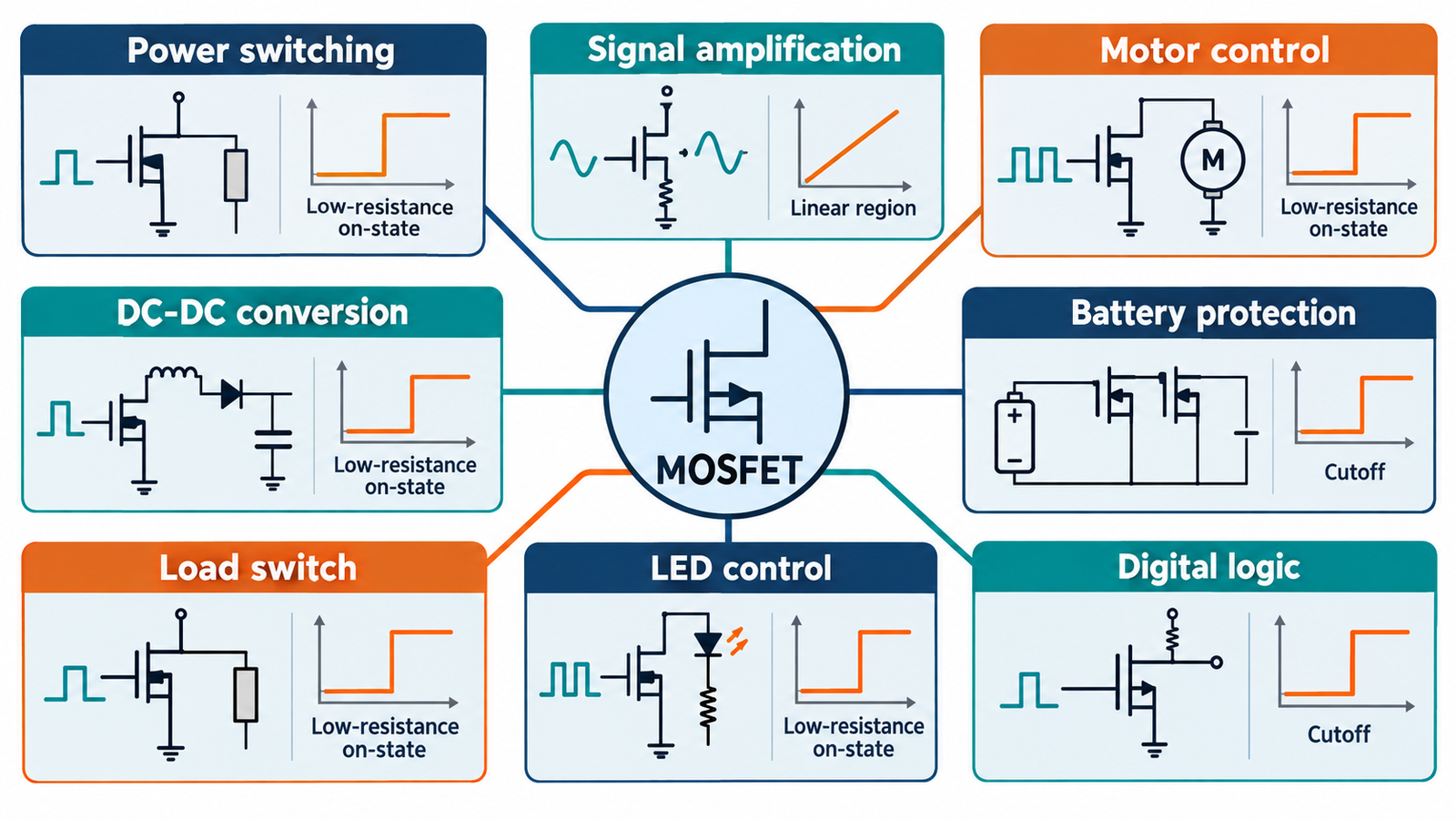
A low-side N-channel MOSFET can connect a load to ground; a high-side device or controller can connect it to the positive rail. Applications include LEDs, heaters, solenoids, relays, fans, battery loads, and power distribution. When fully enhanced, low RDS(on) reduces voltage drop and loss. When off, the device blocks within its voltage and leakage limits.
The practical connection guide at how to wire a MOSFET covers gate resistors, pull resistors, flyback paths, grounds, and high-side drive.
Switch-mode power conversion
Buck, boost, flyback, forward, resonant, inverter, and power-factor-correction circuits use MOSFETs to chop energy into inductors and transformers. High-frequency switching can make magnetics smaller and efficiency high. Synchronous rectifiers replace some diodes with controlled MOSFETs to reduce forward drop, especially at low output voltage.
Explore the full energy path in what a switching power supply is. The switch does not regulate alone; controller, magnetics, capacitors, feedback, protection, and layout form the converter.
Motors, actuators, and inverters
Half bridges and three-phase bridges modulate voltage and current in DC, brushless DC, stepper, and AC motors. Gate drivers provide rapid charge movement and level shifting. Dead time prevents both devices in one bridge leg from conducting simultaneously. Current sensing and overcurrent shutdown protect against stalls and shorts.
Inductive energy requires a controlled path through body diodes, external diodes, synchronous devices, or clamps. Voltage margin must include cable and commutation overshoot. Layout and thermal design become as important as the transistor rating.
Analog and audio amplification
Biased in its active region, a MOSFET converts a small gate-voltage change into a drain-current change. Common-source stages provide voltage gain, source followers provide buffering, and differential pairs compare signals. Power audio amplifiers may use MOSFET output stages, while Class D amplifiers switch them for efficiency.
See what a MOSFET amplifier is for bias, gain, bandwidth, safe operating area, and linear-versus-switching distinctions.
Battery protection and power-path management
Back-to-back MOSFETs can block current in both directions for battery protection, hot-swap, reverse-polarity control, and electronic fuses. Ideal-diode controllers drive a MOSFET to emulate a low-loss diode. Load switches add slew-rate control, current limiting, discharge, and fault reporting.
The intrinsic body diode means a single MOSFET does not block both directions when off. Orientation and topology therefore matter. Protection systems must consider surge, inrush, short-circuit energy, reverse connection, and the failure mode of the controller and MOSFET.
CMOS digital logic
Complementary MOS technology pairs N-channel and P-channel devices so a static logic gate ideally draws little DC current except leakage. CPUs, memories, microcontrollers, sensors, and mixed-signal ICs are built from enormous MOSFET networks. These microscopic devices switch capacitances at low voltage and are not interchangeable with discrete power transistors.
The term CMOS describes a circuit technology using complementary MOSFETs, not a separate replacement for the MOSFET concept. Process geometry and integration goals dominate their design.
Choose and apply a MOSFET correctly
Start with drain-source voltage and transient margin, then current, hot RDS(on), switching frequency, gate-drive voltage, total gate charge, capacitances, body-diode behavior, avalanche or linear safe operating area, package, and thermal resistance. Check the data-sheet test conditions. A high current number may assume an unrealistic case temperature.
Calculate heat using the real waveform and read why MOSFETs get hot. Validate startup, shutdown, overload, inductive turn-off, hottest ambient, minimum airflow, and device tolerances on hardware.
Match the MOSFET family to the application
Begin with the operating quadrant and time scale. A logic transistor switches tiny capacitances; an analog device may remain in saturation for signal gain; a trench power MOSFET minimizes resistance; an RF device controls gain and capacitance at microwave frequencies; and a high-voltage superjunction device balances blocking voltage with switching charge. Package, cell geometry, gate oxide, termination, and qualification are optimized around those jobs.
For a real project, write a one-line device mission such as “24 V low-side solenoid switch at 3 A and 20 kHz” or “400 V half-bridge switch at 100 kHz.” Add transients, ambient, cooling, drive source, fault response, lifetime, and applicable qualification. That statement makes catalog filtering meaningful and prevents accidental comparison of incompatible headline numbers. Once candidates are chosen, design the driver, protection, commutation path, PCB, and thermal system around the same operating conditions used in the loss calculation.
Frequently asked questions
Is a MOSFET a transistor?
Yes. It is a field-effect transistor whose insulated gate controls a conductive channel between source and drain.
Does a MOSFET amplify or switch?
It can do either. Bias and circuit topology determine whether it operates linearly or mainly in the on and off states.
Does the MOSFET gate draw current?
It draws almost no steady DC current ideally, but the driver must supply transient current to charge and discharge gate capacitances.
Can a microcontroller drive any MOSFET directly?
No. Check required gate voltage, charge, frequency, peak drive current, source reference, and switching loss. Many applications need a gate driver.