Power MOSFETs
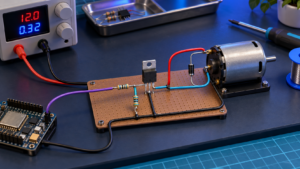
How to Wire a MOSFET: Low-Side and High-Side Circuits
Wire a MOSFET correctly with the right source, drain, gate, pull resistor, flyback path, ground reference, decoupling, and high-side driver connections.
Browse: Power Diode Power Mosfet Power Transistors
Technical knowledge hub
Selection, switching behavior and practical design guidance for power MOSFETs.
Wire a MOSFET correctly with the right source, drain, gate, pull resistor, flyback path, ground reference, decoupling, and high-side driver connections.
Yes, a MOSFET is a field-effect transistor. See how it controls current and how it differs from BJTs, JFETs, IGBTs, and CMOS technology.
MOSFET stands for metal-oxide-semiconductor field-effect transistor. Learn what each term means, how the insulated gate controls current, and where MOSFETs are used.
See how gate-to-source voltage creates a channel, how MOSFET operating regions control current, and why charge, capacitance, heat, and layout affect switching.
Follow a MOSFET through a practical switching circuit, including gate drive, body-diode action, inductive loads, PWM, losses, layout, and protection.
Understand the MOSFET switching cycle in converters and motor drives, from gate charge and conduction to commutation, losses, layout, thermal design, and testing.
Learn what a MOSFET is, how its gate controls current, how N-channel and P-channel devices differ, and which ratings matter in real circuits.
MOSFET describes a transistor, while CMOS describes a circuit and fabrication approach built mainly from complementary N-channel and P-channel MOSFETs.